Wednesday, September 9, 2026

​The Garment Must Now Carry Its History

Why proof of origin could become the next dividing line in India’s textile exports

A garment can have perfect stitching, the right colour and an attractive price, yet still face questions that its quality cannot answer. Where did the fabric come from? Which factory processed it? What actually happened in India? Can the exporter connect the finished product to the materials and production stages behind it?

For India’s textile industry, these questions reach far beyond the shipping department. They suggest a future in which manufacturing competitiveness will depend partly on the ability to prove how manufacturing happened. The fabric will carry the design. The records will carry its credibility.

The return of geography. For decades, international trade encouraged businesses to divide production across countries. Cotton could originate in one economy, become yarn in another, turn into fabric elsewhere and finally reach a garment factory thousands of kilometres away. This was the working logic of global production.

The removal of restrictions under the WTO Agreement on Textiles and Clothing on 1 January 2005 marked a major historical transition. Textile trade moved out of its special quota regime and into the general multilateral trading framework. Geography continued to matter, but firms gained greater room to organise production around costs, capabilities and delivery. (wto.org)

Today, geography is acquiring a different commercial meaning. The country attached to a product can shape its treatment at the border and the scrutiny it attracts. The emerging contradiction is sharp: businesses built international supply chains to become efficient, while governments increasingly demand a clearly established national origin for the final product.

On 3 September 2026, Commerce Minister Piyush Goyal called for credible Indian country-of-origin certificates and genuine value addition, warning against India becoming a channel for goods from elsewhere through marginal processing. His message places the credibility of Indian production at the centre of export policy. (indianexpress.com)

Suspicion must not become evidence. The White House report on transshipment places India among large trading economies where suspected risks exist alongside substantial legitimate commerce. However, it also acknowledges that changing trade patterns do not establish that displaced Chinese exports were illegally rerouted. Real investment, production relocation and legitimate sourcing changes explain part of the shift. (whitehouse.gov)

That distinction deserves more attention than the accusation. An increase in exports is a reason to examine production evidence, not a verdict against the exporter. If every change in sourcing becomes suspicious, countries are effectively being discouraged from achieving the supply-chain diversification that international buyers have encouraged.

India therefore needs a firm position on both sides: false origin claims should face scrutiny, and legitimate manufacturers should be protected from broad allegations unsupported by shipment-level evidence. Export credibility requires honest businesses and fair enforcement.

The small supplier becomes the large exporter’s vulnerability. Consider an illustrative garment order passing through a fabric supplier, a dyeing unit, a cutting contractor, an embroidery workshop and a stitching factory. The finished product may be entirely consistent with the declared production process. Yet the evidence may sit in disconnected invoices, handwritten job-work registers and messages on different phones.

The difficulty is not simply having documents. It is connecting them. A purchase invoice identifies a transaction, but may not establish which fabric batch entered a particular export order. A production entry records activity, but becomes more useful when it can be linked to material quantities and dispatch records.

Origin documentation also serves a different purpose from labour and environmental evidence. A record showing where fabric was processed does not establish safe working conditions or responsible wastewater treatment. Exporters need related systems that can answer these different questions without pretending that one certificate proves everything.

The commercial risk is that a weak link in documentation can spread beyond the supplier responsible for it. An exporter may face questions it cannot answer quickly, even when the underlying production is legitimate.

The hidden price of proving innocence. Documentation has an economic cost. It takes staff time, training and coordination. When records are questioned, delayed acceptance or payment can add financing pressure.

Consider a purely illustrative calculation. An additional compliance cost of ₹50,000 equals 2.5% of a ₹20 lakh order, but only 0.25% of a ₹2 crore order. The same fixed cost creates very different burdens. This is why apparently uniform requirements can favour larger firms.

A future textile industry could therefore become more concentrated even without major differences in manufacturing efficiency. Small producers may lose access because they cannot afford the systems needed to demonstrate their capabilities. Policy should recognise this possibility before interpreting every business exit as a failure of productivity.

Clusters need a shared capacity to establish facts. Tiruppur, Surat, Ludhiana, Panipat and Jaipur should treat traceability as a collective development challenge. Shared testing facilities help firms establish product quality. Shared documentation services could help them establish the production history behind each shipment.

The starting point should be practical: consistent supplier declarations, clear material lists, batch references and job-work records that connect inputs to finished goods. Cluster associations could support trained documentation teams and affordable digital tools, with independent checks where appropriate. Such services would support compliance; they would not replace the applicable origin rules or guarantee customs acceptance.

The system should accommodate the small workshop that contributes specialised work but has limited administrative capacity. Simple interfaces, local-language assistance and reusable records would matter more than an impressive technology launch.

Confidentiality also matters. Suppliers should not have to expose their entire customer base, pricing or commercial relationships to every participant. Shared infrastructure needs clear access controls and accountability.

Digitisation alone will solve little. A false declaration remains false after it enters a database. The real task is to make records consistent with actual production.

Predictability must travel in both directions. Exporters are being asked to provide greater certainty about their supply chains. They need greater certainty about domestic policy as well. The official RoSCTL extension covers apparel and made-ups until 30 September 2026, or approval for the next Finance Commission cycle, whichever comes earlier. 

This uncertainty affects pricing decisions. Businesses accepting orders for later delivery need to understand the support available when those shipments leave. Demanding precise commercial planning while leaving policy decisions close to expiry creates an avoidable burden.

Origin integrity should therefore be strengthened through standard records, targeted checks, clear explanations and timely resolution of disputes. Repeatedly asking every small exporter to reconstruct the same production history would consume resources without necessarily improving enforcement.

The next export advantage will include the cost of being believed. In the coming years, buyers and border authorities may become better at comparing shipment records, supplier relationships and claimed production capacity. Exporters with coherent evidence could become easier to assess and more attractive to buyers seeking dependable supply.

India has an opportunity to make that confidence accessible across its textile clusters. The strategic challenge is to help thousands of small firms demonstrate real production without burying them under the cost of doing so.

Made in India must carry a history that can be checked. The test of good policy will be whether an honest small manufacturer can tell that history clearly, affordably and once.


#TextileExports #MSMEs #MadeInIndia #Traceability #ClusterDevelopment


Tuesday, September 8, 2026

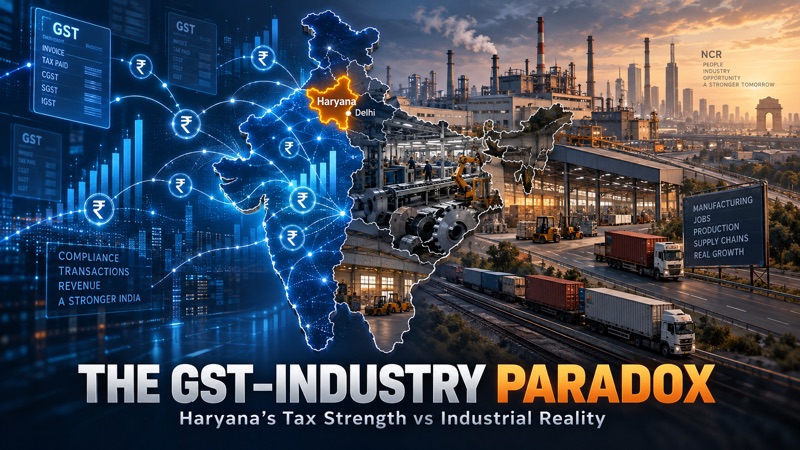
Why Tax Collection Does Not Reveal the Real Industrial Map of India

One Country, Three Different Economic Maps

India does not have one economic map. It has at least three. The first shows where goods are manufactured. The second shows where income and value are created. The third shows where taxable transactions are recorded. These maps overlap, but they are not identical.

This difference becomes visible when GST collections are compared with industrial production. Maharashtra leads GST collection because it combines manufacturing, finance, corporate headquarters, ports, services and a large consumer market. Gujarat has a far more industry-intensive economy, but its GST share is lower than Maharashtra. Delhi produces relatively little industrial output but collects substantial GST. Haryana contributes only around 3.6 to 3.7 per cent of India’s GDP, yet it generates approximately 7.1 per cent of the domestic GST attributed to states.

The simple conclusion would be that Haryana is producing far more than its economic size suggests. The more accurate conclusion is different. Haryana has become one of India’s densest centres of formal, taxable and corporate economic activity. Its GST strength comes not only from factories, but also from Gurugram’s corporate economy, NCR consumption, automobile trade, warehousing, logistics, real estate and business services.

This is why GST should never be treated as a direct measure of industrialisation.

India’s Top GST States and Their Industrial Reality

During 2024–25, Maharashtra collected approximately ₹3.58 lakh crore in gross GST and contributed more than one-fifth of domestic GST attributed to states. Karnataka followed with around ₹1.59 lakh crore, Gujarat with ₹1.36 lakh crore, Tamil Nadu with ₹1.31 lakh crore and Haryana with ₹1.19 lakh crore. Uttar Pradesh, Delhi, West Bengal, Telangana and Odisha completed the leading group.

But their industrial structures are sharply different.

Industry contributes around 42 to 43 per cent of Gujarat’s state value added. In Odisha, the proportion is also above 43 per cent because mining, metals, power and large mineral-based industries dominate the economy. Tamil Nadu has a more diversified industrial structure, with industry contributing roughly one-third of its state value added. Maharashtra’s industrial share is only around one-fourth, yet it leads India in GST because it combines industrial production with finance, services, imports, consumption and corporate transactions.

Delhi represents the opposite extreme. Industry has a relatively small presence in its economy, but the city records high GST because it is a major centre of consumption, trade, distribution, professional services and company registrations.

The comparison reveals a fundamental fact. A state can be highly industrialised without becoming a proportionately large GST collector. It can also generate high GST without being a major industrial producer.

The Haryana Puzzle

Haryana is perhaps the most important case in this comparison.

Industry accounted for approximately 29.2 per cent of Haryana’s Gross State Value Added in 2023–24. Manufacturing contributed 17.7 per cent, construction 9.2 per cent, electricity and utilities 2.1 per cent, and mining only 0.2 per cent. Services contributed 52.9 per cent, while agriculture and allied activities accounted for 17.9 per cent. (ncaer.org⁠)

Haryana, therefore, is not overwhelmingly industrial in the way Gujarat or Odisha is. Its industrial share is close to the average of Indian states. Yet Haryana collected approximately ₹1,19,362 crore in gross GST during 2024–25 and ranked fifth among all states. Its per-capita GST collection was approximately ₹47,083, the highest among major states. (cdnbbsr.s3waas.gov.in⁠)

The contrast is striking. Haryana contributes approximately 3.6 to 3.7 per cent of India’s GDP, around 4.5 per cent of national industrial output and nearly 7.1 per cent of domestic GST attributed to states.

This is not an accounting accident. It reflects the unusual economic geography of the state.

Gurugram hosts the headquarters, regional offices and service operations of major automobile, technology, consulting, financial, real-estate and consumer companies. Faridabad, Manesar, Gurugram, Sonipat, Panipat, Yamunanagar, Bahadurgarh and other industrial centres add manufacturing depth. The state also benefits from proximity to Delhi, high household incomes, extensive road connectivity and a large formal business base.

Haryana is therefore more than an industrial economy. It is a manufacturing, consumption, logistics and corporate-registration economy operating within the wider National Capital Region.

GST Measures Transactions, Not Factories

The misunderstanding begins with the assumption that high GST collection must mean high production. GST is a destination-based tax. It broadly follows consumption and taxable transactions rather than the physical location of production.

A factory may manufacture a product in one state, but the final tax revenue can move towards the state where that product is consumed. Similarly, a corporate office, warehouse, service centre or large distributor can generate substantial GST without owning a large manufacturing plant.

GST collection is also influenced by formalisation. Two states may have similar levels of economic activity, but the state with better invoicing, stronger compliance, more organised retail and a larger registered business base may report much higher GST.

This creates an invisible divide between the formal economy and the productive economy. GST sees the part of economic activity that enters the tax network. It does not fully capture informal manufacturing, household enterprises, agricultural activity, exempt goods or the real technological quality of production.

A state can therefore collect high GST while having weak manufacturing capability. Another can produce large quantities of industrial goods but collect less GST because much of the final consumption occurs elsewhere.

The Historical Change from Production Centres to Transaction Centres

Before economic liberalisation, the industrial importance of a state was largely associated with factories, public enterprises, electricity generation, mining and physical infrastructure. Industrial maps were built around steel plants, textile mills, engineering centres, ports and mineral belts.

The post-1991 economy changed this relationship. Services expanded, supply chains fragmented and corporate functions became geographically separable from production. A factory could be located in one state, its head office in another, its warehouse in a third and its consumers across the country.

GST deepened this transformation after 2017 by creating a national indirect-tax system based largely on destination and invoice trails. It improved transparency and reduced many internal tax barriers, but it also made state-level GST collection a hybrid indicator. It now reflects consumption, formalisation, corporate organisation, logistics and services alongside production.

The modern economic centre is no longer always the place where machines are installed. It may be the place where orders are processed, invoices are raised, services are supplied, goods are distributed and final consumption takes place.

Why Gujarat and Odisha Look Different from Haryana

Gujarat’s industrial strength is rooted in chemicals, petrochemicals, engineering, pharmaceuticals, automobiles, textiles, ceramics, ports and energy-intensive production. Its industrial share is very high, and its contribution to national industrial output is estimated to be around 14 per cent.

Odisha’s economy is even more industry-intensive in proportional terms, but much of its industrial base is concentrated in mining, metals and capital-intensive production. These sectors can generate enormous output without producing an equally large number of taxable retail transactions or jobs.

Haryana’s industrial share is lower, but its economy produces more transactions per unit of output. Its location beside Delhi, high-income consumers, formal enterprises and corporate concentration enlarge the GST base.

This means Gujarat may be more industrially deep, Odisha more resource-intensive and Haryana more transaction-intensive. GST alone cannot reveal these differences.

The Danger of Rewarding Collection Instead of Capability

Policy can become distorted when high GST is treated as evidence of successful industrialisation. A state may improve tax administration and consumption without developing technological capability, industrial employment or domestic supply chains.

Similarly, a state with mines, power plants, steel factories and intermediate-goods industries may contribute significantly to national production but appear fiscally weaker because final demand and corporate transactions are recorded elsewhere.

The danger is that governments may begin competing mainly for headquarters, warehouses, commercial registrations and high-income consumption. These activities are valuable, but they cannot substitute for industrial capacity.

Factories create production ecosystems. They support tool rooms, repair services, logistics companies, component manufacturers, testing laboratories and skilled employment. Corporate offices create high-value jobs but often generate fewer backward linkages with local MSMEs. A balanced state economy needs both.

What Haryana Must Do Next

Haryana’s high GST performance is an advantage, but it can also hide structural weaknesses.

The state remains heavily concentrated around the NCR belt. Gurugram and Faridabad account for a disproportionate share of formal economic activity, while several districts remain dependent on agriculture, traditional industries or low-productivity services. This creates a state with world-class corporate zones existing beside regions with limited industrial diversification.

The next phase of Haryana’s development cannot depend only on real estate, automobiles, corporate services and NCR consumption. It must spread industrial capability into secondary cities and existing clusters.

Panipat can move from conventional textiles towards technical textiles, recycling and sustainable processing. Faridabad can deepen precision engineering, machinery and industrial automation. Manesar and Gurugram can expand from automobile assembly and corporate services into electric mobility, electronics, software-integrated manufacturing and advanced components. Sonipat can become stronger in food processing, logistics and consumer manufacturing. Ambala’s scientific-instrument cluster can move towards medical devices and precision technologies. Yamunanagar can modernise its plywood, paper and engineering base.

The objective should not merely be to increase the number of factories. It should be to raise local value addition, technology absorption, supplier capability and industrial wages.

A Better Way to Judge State Performance

States should be evaluated through a combined economic scorecard rather than a single number. GST collection must be read alongside manufacturing GSVA, total industrial output, exports, factory employment, industrial wages, electricity consumption, investment, technological intensity, MSME productivity and regional distribution.

Under such a framework, Maharashtra would emerge as India’s broadest economic platform. Gujarat would stand out for industrial depth. Tamil Nadu would be recognised for diversified manufacturing and employment. Karnataka would lead in high-value services and technology-linked production. Odisha would appear strong in resource-based industry but weaker in diversification. Haryana would emerge as a compact, formal and transaction-dense economy with substantial but geographically concentrated industrial capacity.

Such a comparison would be more honest than simply ranking states by GST.

The Future Economic Map

The states that dominate GST today may not automatically dominate industrial production tomorrow. The future will be shaped by electronics, semiconductors, electric mobility, renewable-energy equipment, advanced materials, defence production, biotechnology, data infrastructure and automated manufacturing.

These industries will create new production centres, but the resulting GST may still flow disproportionately towards consumption markets, corporate centres and logistics gateways. The gap between the place of production and the place of taxation could widen further.

The central lesson is simple but important. GST tells us where formal taxable transactions are concentrated. Industrial production tells us where productive capability exists. GDP tells us where economic value is generated. None of these indicators can independently describe the full economic strength of a state.

Haryana demonstrates this new economic reality clearly. Its share in national GST is much higher than its share in GDP and industrial output. This reflects a genuine strength in formalisation, income, consumption, logistics and corporate activity. But it should not be mistaken for complete industrial transformation.

The real test for Haryana is whether it can convert its exceptional tax and transaction base into deeper manufacturing, stronger MSME clusters, wider regional development and more productive employment. High GST collection is an achievement. Turning that fiscal strength into broad industrial capability will be the much larger achievement.


#GST #Haryana #IndustrialDevelopment #Manufacturing #MSME #StateEconomy #EconomicPolicy #ClusterDevelopment #IndiaEconomy


Monday, September 7, 2026

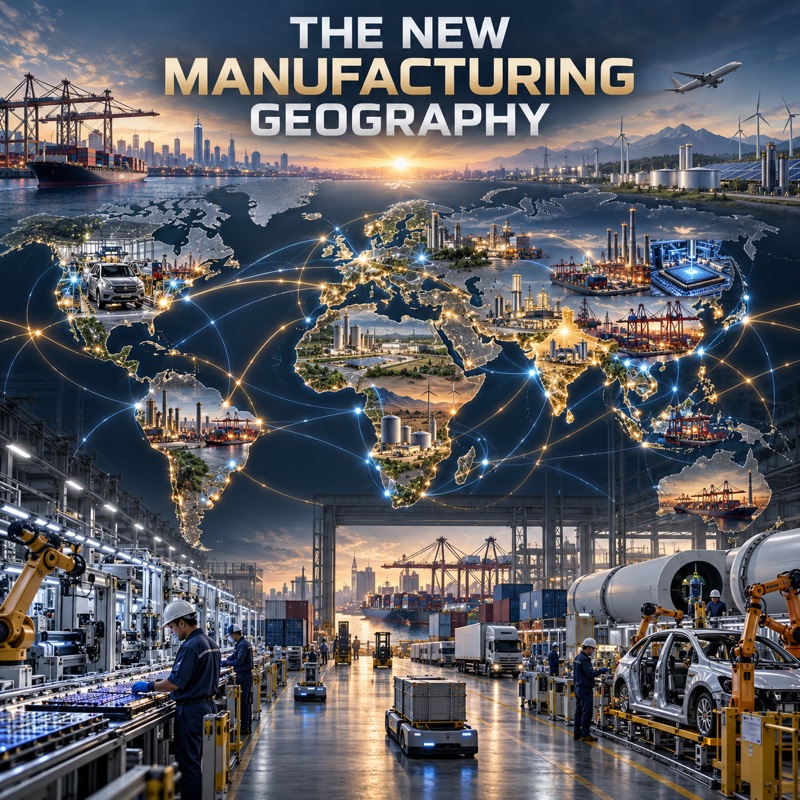
Factories Are Moving, but Industrial Power Is Harder to Move

The industrial map is being redrawn

For nearly four decades, the geography of global manufacturing appeared to have a clear centre. China combined inexpensive labour, industrial infrastructure, efficient ports, huge production capacity, disciplined supplier networks and access to a rapidly expanding domestic market. A company could source components, assemble products, package them and ship them from closely connected industrial regions. This combination was extremely difficult for any other country to match.

That period is not ending through the simple disappearance of Chinese manufacturing. China remains deeply embedded in global supply chains and continues to possess an industrial ecosystem of exceptional scale. What is ending is the assumption that concentrating production in one country is always the most efficient corporate strategy.

Pandemic disruptions, geopolitical rivalry, tariffs, export controls, shipping interruptions and economic-security policies have changed the meaning of efficiency. Companies are now placing greater value on multiple suppliers, political reliability, shorter delivery routes, access to subsidised markets, clean energy and protection from future trade restrictions. The next industrial map will consequently have several production centres instead of one overwhelmingly dominant centre.

But this change must not be misunderstood. Manufacturing is not being redistributed fairly across the world. It is being reorganised selectively around countries that can offer the right combination of cost, capability, connectivity, market access and political acceptability.

Globalisation is being rewired, not reversed

The popular language of reshoring suggests that factories are simply returning to advanced economies. This is only partly true. High-value and strategically sensitive activities such as semiconductors, defence electronics, batteries and medical technologies may receive large subsidies to move closer to major consumer markets. However, labour-intensive and commercially competitive production cannot be relocated entirely to high-cost economies without raising prices substantially.

The more likely future is a mixed manufacturing system. Some production will return home. Some will move closer to final markets. Some will be placed in politically friendly countries. Some will remain in China, while additional capacity is developed elsewhere as insurance.

Global value chains therefore remain central to trade. WTO analysis indicates that value-chain trade still accounted for about 46.3 per cent of global trade, only moderately below its recent peak. The emerging transformation is not deglobalisation in its pure form. It is a more guarded and politically filtered form of globalisation. 

This distinction matters. Countries waiting for a mass departure of factories from China may be disappointed. Most multinational companies are not searching for a complete substitute for China. They are searching for supplementary production locations that can reduce concentration risk without destroying efficiency.

The new contenders are not competing on the same strengths

India enters this transition with scale. It offers a large workforce, an expanding domestic market, engineering capabilities, digital infrastructure and established strengths in pharmaceuticals, automobiles, chemicals, textiles and information technology. Its greatest opportunity is not simply to become a low-cost assembly location. It is to connect its domestic market, MSME clusters and technical talent with global production networks.

Yet India’s size can conceal serious weaknesses. Industrial land, urban congestion, port connectivity, regulatory unpredictability, contract enforcement, quality certification and the availability of technically trained workers continue to vary sharply across states and districts. A large population does not automatically become an industrial workforce. Nor does a large domestic market guarantee export competitiveness.

Vietnam has benefited from its disciplined export orientation, trade agreements, proximity to Asian supplier networks and success in electronics and consumer manufacturing. But its smaller labour force, growing wages and dependence on imported components may limit how much production it can absorb.

Mexico possesses a different advantage. Its location next to the United States gives it extraordinary potential in automobiles, electronics, appliances, medical equipment and other sectors where delivery time matters. Nearshoring can shorten supply chains, but Mexico still faces constraints involving electricity, water, security, transport capacity and uneven governance.

Indonesia combines natural resources, a large domestic market and ambitions in nickel processing, batteries and electric vehicles. Its risk is that resource-based industrialisation may create processing capacity without generating enough technological depth, domestic suppliers or quality employment.

Malaysia has strong electronics experience, better infrastructure and an established role in semiconductor-related production. However, it faces skilled-labour constraints and competition from both lower-cost Asian economies and heavily subsidised advanced countries.

Poland and Turkey benefit from proximity to European markets. Poland is well placed in machinery, automotive components, batteries and business services, while Turkey has strengths in textiles, machinery, appliances and flexible production. Yet energy costs, political tensions, demographic pressures and economic instability could affect their long-term attractiveness.

Selected African economies may eventually capture labour-intensive manufacturing as Asian wages rise. Countries such as Morocco, Egypt, Kenya, Ethiopia, Rwanda, Ghana and South Africa possess different combinations of market access, location, labour, resources and industrial experience. But Africa should not be treated as a single manufacturing destination. The decisive competition will occur between particular cities, ports, corridors and industrial clusters rather than between entire continents.

The factory is only the visible part of manufacturing

Governments often celebrate the announcement of a new plant as if industrialisation has already occurred. But a factory can remain an isolated production island. It may import most components, machinery, designs and technology, perform limited assembly, receive fiscal incentives and export the finished product without creating strong connections with the domestic economy.

Real industrial development begins when investment produces local suppliers, technical knowledge, managerial capabilities, testing facilities, specialised logistics, tool rooms, repair services, research institutions and trained workers. The strength of China-centred manufacturing did not come from individual factories alone. It came from dense ecosystems in which thousands of firms could solve production problems quickly.

This is the central weakness in many aspiring manufacturing economies. They offer cheap labour and tax incentives but lack the invisible industrial infrastructure surrounding a competitive factory. A manufacturer may tolerate wages that are slightly higher than expected. It cannot easily tolerate unreliable electricity, delayed customs clearance, inconsistent components, repeated compliance failures or the absence of maintenance engineers.

The World Bank’s logistics framework appropriately assesses not only physical infrastructure but also customs, shipment reliability, tracking systems, logistics competence and delivery timeliness. This shows why building highways alone cannot guarantee manufacturing competitiveness. 

The opportunity may be large, but the investment is becoming concentrated

The manufacturing transition is occurring during a difficult global investment environment. UNCTAD reports that global foreign direct investment reached about 1.6 trillion dollars in 2025, but more than 80 per cent went to the leading 20 host economies. It also found that investment was becoming concentrated in a narrow group of countries, sectors and large projects. 

This produces an uncomfortable conclusion. Supply-chain diversification does not mean that every developing country will receive factories. Capital will move towards a limited number of locations that already possess industrial capabilities. Countries with stronger ecosystems may capture additional investment, while weaker economies fall further behind.

There is also a difference between announced investment and operating production. Governments frequently count memoranda, proposed industrial parks and investment commitments as economic achievements. But projects can be delayed, reduced or abandoned when demand weakens, financing costs rise or trade policies change. The true measurement should be operating factories, domestic value addition, supplier contracts, worker productivity, technology absorption and sustained exports.

Cheap labour is losing its old power

The twentieth-century route to industrialisation often began with abundant low-cost labour. That route is becoming narrower. Robotics, artificial intelligence, digital quality control and advanced production systems are reducing the labour required for many manufacturing activities. Carbon rules and product-traceability requirements are adding new costs. Buyers increasingly want evidence about emissions, materials, labour conditions and supply-chain origin.

The factory of the future may employ fewer unskilled workers but require more technicians, machine operators, data specialists, energy managers and compliance professionals. Countries that rely only on low wages may discover that automation in a higher-cost economy is more reliable than labour-intensive production in a poorly connected location.

This makes skills policy central to manufacturing policy. Traditional vocational training often produces certificates without production competence. Training must be designed with factories, updated continuously and linked to real machinery, maintenance practices, digital systems and quality standards.

Industrial policy has returned, but not every subsidy builds an industry

Governments across advanced and emerging economies are again using subsidies, tax incentives, local-content rules, public procurement and strategic investment funds. UNIDO notes that high-income economies introduced industrial policies at roughly five times the rate of developing economies over the preceding decade. 

This creates an uneven contest. Rich countries can spend enormous amounts to attract semiconductor, battery and clean-technology projects. Developing countries may respond by offering tax holidays and discounted land, sometimes without calculating whether the investment will create lasting domestic capabilities.

A subsidy can attract a plant, but it cannot manufacture an ecosystem. Poorly designed incentives may transfer public resources to global corporations while leaving local firms outside the supply chain. The stronger approach is to connect incentives with worker training, technology transfer, domestic supplier development, research collaboration, export performance and measurable local value addition.

UNIDO estimates that one manufacturing job can potentially support more than two additional jobs elsewhere in the economy. But this multiplier emerges only when the factory purchases services and inputs locally. If everything is imported, the developmental effect becomes much smaller. 

India must build manufacturing regions, not announce isolated schemes

For India, the opportunity is historically significant, but the country must avoid confusing geopolitical possibility with industrial achievement. Global companies may want alternatives to concentrated production, yet they will not move merely because India is large or politically important.

India needs a geographically precise strategy. Different regions should specialise according to existing capabilities. Electronics corridors require component suppliers, clean rooms, reliable power and precision logistics. Textile clusters need design, sustainable processing, water management and rapid market response. Pharmaceutical regions require strong laboratories, regulatory discipline and research capability. Food-processing clusters need cold chains, traceability and organised links with farmers. Engineering clusters require common testing, advanced machinery and skilled technicians.

MSMEs must sit at the centre of this strategy. Large anchor factories may generate impressive investment figures, but local supplier networks determine whether manufacturing capability spreads through the economy. Common facilities, testing laboratories, design centres, tool rooms, digital platforms and cluster-based training can allow smaller firms to meet global requirements.

The objective should not be to attract any factory at any cost. It should be to increase domestic value addition, technological learning and the number of competitive local suppliers.

The future industrial map will be green, digital and political

The next manufacturing geography will not be shaped by wages and transport costs alone. Access to renewable electricity will influence investment as carbon reporting expands. Water availability will determine the viability of textiles, chemicals, food processing and semiconductor plants. Digital security will become important as factories become connected. Political alliances will affect access to technology, finance and markets.

Manufacturing locations may therefore be selected through a new calculation:

Production cost plus logistics risk plus carbon cost plus geopolitical exposure plus institutional reliability.

This formula will favour countries that can provide clean power, predictable regulation, efficient ports, secure digital systems, skilled labour and trusted trade relationships. It may also shift production within countries. Coastal corridors, border regions and well-governed states may advance faster than national averages suggest.

The harsh truth behind the opportunity

The new manufacturing geography will create winners, but it will not automatically create development. Some countries will obtain assembly plants without technology. Some will process minerals without moving into advanced products. Some will grant subsidies without developing suppliers. Others will build industrial parks that remain partly empty because roads, skills and electricity were treated as separate policy subjects.

The real competition is not China versus India, Vietnam or Mexico. It is industrial ecosystem versus industrial aspiration.

China’s manufacturing dominance was built over decades through infrastructure, skills, scale, supplier density, technology absorption and persistent state coordination. No country can reproduce that depth through a few investment summits or incentive packages.

The coming redistribution of production offers India, Southeast Asia, Mexico, Eastern Europe, Turkey and parts of Africa a rare opening. But the window may not remain open indefinitely. Automation can reduce the need to relocate. Trade barriers can discourage new investment. Political uncertainty can freeze corporate decisions. Early beneficiaries may accumulate supplier networks and make it increasingly difficult for latecomers to enter.

The factories of the future will go where promises are converted into production reliability. Countries that build ports but neglect customs, train workers without consulting industry, offer cheap land without dependable energy, or attract multinational companies without upgrading domestic enterprises will remain manufacturing locations on paper.

The industrial map is changing. Geography has created the opening, but institutions will decide who captures it.


#Manufacturing #GlobalSupplyChains #India #MSME #IndustrialPolicy #ChinaPlusOne #Exports #EconomicDevelopment #GlobalTrade #FutureOfManufacturing


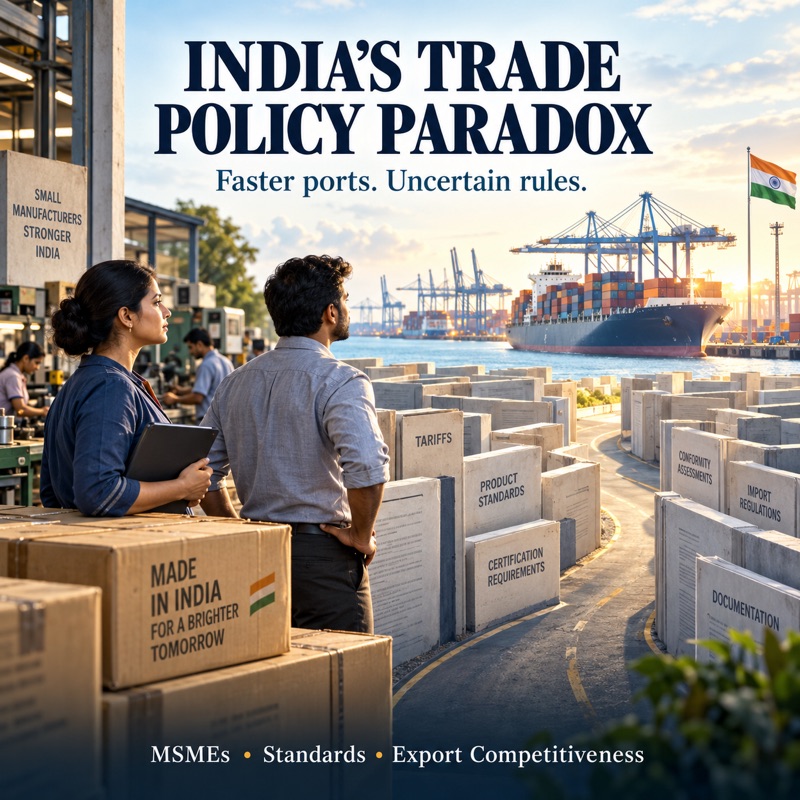
​India’s Trade Policy Paradox: Faster Ports, Uncertain Promises

A factory can become more efficient and still become less competitive. Its workers may produce more, its machines may waste less, and its sh...