
Thursday, August 6, 2026

Handmade India: Growth, Government Support and the Marketing Strategy That Is Still Missing

India does not have one clearly defined statistical category called handmade products. The sector is spread across handicrafts, handlooms, carpets, village industries, tribal products, products made by self-help groups, handmade jewellery, natural-fibre goods, artisanal food products and craft-based fashion. Therefore, any single market-size estimate should be treated cautiously.

The most reliable comparable indicator is handicraft exports. Exports of handicrafts excluding hand-knotted carpets increased from ₹20,082.53 crore in 2014–15 to ₹33,122.79 crore in 2024–25. This represents cumulative growth of about 65 per cent and an annual compound growth rate of approximately 5.1 per cent in rupee terms. In FY2024–25, handicraft exports were valued at roughly US$3.89 billion. 

This is growth, but not yet transformation.

A sector employing millions of people, carrying centuries of cultural knowledge and supplying products to global home, lifestyle, fashion and gift markets should arguably have expanded much faster. Once inflation, exchange-rate movements and rising material costs are considered, the real increase in artisan production and income may be much smaller than the export figures suggest.

The growth paradox

India possesses almost every ingredient needed to become the world’s leading handmade economy: an enormous diversity of skills, low-volume production capability, cultural authenticity, natural materials, regional identities, a large artisan base and an expanding global interest in sustainable and traceable products.

Yet India continues to sell a significant share of its handmade products as anonymous merchandise.

The object may be made in India, but the customer relationship, design ownership, brand value, retail margin and market information are frequently controlled elsewhere. An artisan may receive the smallest part of the final price even though craftsmanship is the product’s central source of value.

This is the basic contradiction of the sector. India is rich in making but weak in market ownership.

Growth has also been uneven. Export-ready manufacturers and organised craft enterprises can participate in fairs, meet buyers, manage compliance and supply large orders. Individual artisans and small producer groups frequently struggle with product photography, packaging, price calculation, barcoding, cataloguing, digital advertising, customer service, working capital and timely delivery.

The market is expanding, but access to that market remains highly unequal.

What marketing facilities does the government provide?

Government assistance is not insignificant. It operates through several ministries, programmes and institutions.

Under the Ministry of Textiles, support includes domestic marketing events, Gandhi Shilp Bazars, exhibitions, fashion shows, buyer-seller meetings, reverse buyer-seller meetings, international fairs, craft exposure programmes and virtual marketing events. EPCH organises major trade platforms, including the India Handicrafts and Gifts Fair, and provides export information, market studies and international promotion support. 

Handloom and artisan entities are also being connected with Government e-Marketplace. As of July 2026, the government reported that 6,865 weavers or handloom entities had been onboarded on GeM, while 143 marketing events had been organised and several Urban Haats were operating in Uttar Pradesh. 

Under the National Rural Livelihoods Mission, products made by women’s self-help groups are promoted through SARAS Aajeevika Melas, the SARAS Collection on GeM, the eSARAS platform and partnerships with Amazon, Flipkart, Meesho and JioMart. eSARAS has also been connected with ONDC. 

Other support mechanisms include Geographical Indication registration, India Handloom Brand, Handicrafts Mark, design development, artisan identity cards, cluster development, training, toolkits, credit support, packaging assistance and schemes such as PM Vishwakarma.

These facilities create visibility and some transaction opportunities. However, visibility should not be confused with a complete marketing system.

The Kunj: important infrastructure, but not yet a national strategy

The Kunj was inaugurated in New Delhi on 21 August 2025. It was developed by the Office of the Development Commissioner Handicrafts as a flagship retail and cultural destination for Indian handicrafts and handlooms. Its concept combines curated retail, exhibitions, demonstrations, workshops, cultural activity and contemporary presentation. 

The Kunj is strategically important because it tries to change the visual language of Indian craft. Instead of presenting handmade products only in temporary stalls or crowded fairs, it places them in an organised, design-led and premium environment.

That change is necessary. Presentation influences price perception. A product displayed as a souvenir receives one price. The same product, documented, curated and presented as collectible design may receive a completely different price.

But a critical distinction must be made: The Kunj is a marketing asset; it is not yet a marketing architecture.

A flagship centre in Delhi can serve tourists, diplomats, designers, urban consumers and institutional buyers. It cannot by itself solve the market problems of artisans in Kutch, Kinnaur, Bhagalpur, Kutch, Kashmir, Odisha, the Northeast, Tamil Nadu or central India.

Its success should therefore not be assessed primarily by visitor numbers, inaugurations or the beauty of the premises. It should be evaluated through measurable economic outcomes:

  • value of annual sales;
  • number of repeat customers;
  • export orders generated;
  • proportion of the retail price reaching producers;
  • number of artisans graduating into independent brands;
  • average order size;
  • repeat purchase rate;
  • product rejection rate;
  • women artisans’ income growth;
  • number of institutional and international buyers acquired.

Without these indicators, The Kunj risks becoming an elegant showroom surrounded by an unchanged production system.

The weakness of the existing government approach

Much of the current system is organised around events. Artisans are taken to a fair, given a stall, exposed to customers and then expected to manage the rest.

This event-centred model produces episodic sales rather than permanent market access.

A fair may generate revenue for ten days. An effective marketing system must generate orders for twelve months. It must collect customer data, maintain inventories, analyse which products are selling, arrange repeat production, manage logistics, settle payments and help producers improve future collections.

The second weakness is that assistance is often scheme-led rather than market-led. Government agencies may count the number of artisans trained, exhibitions organised, stalls allocated or products uploaded. The market, however, asks different questions: Was the product relevant? Was the quality consistent? Was it delivered on time? Did the customer reorder? Was the price competitive? Could production be scaled without destroying authenticity?

The third problem is platform fragmentation. An artisan may be listed on GeM, ONDC, eSARAS or a private marketplace but receive few orders. Digital onboarding is only the opening of a door. It does not guarantee that buyers will enter.

Successful e-commerce requires search optimisation, professional images, reviews, advertising, fulfilment, returns management, multilingual customer support and continuous catalogue renewal. Most artisan groups cannot manage these functions individually.

The fourth problem is the absence of demand intelligence. Production is frequently based on inherited designs, government training modules or what sold in the previous exhibition. There is limited real-time information on changing colours, sizes, home-interior trends, gifting seasons, sustainability claims, overseas regulations or consumer price bands.

India continues to produce first and search for the customer later. Modern marketing begins with the customer and works backward towards design and production.

A precise long-term marketing strategy for handmade products

India requires a ten-year Handmade India Market Development Mission. It should not be another subsidy programme. It should be a commercially managed market-building system connecting artisans, designers, exporters, retailers, hotels, architects, e-commerce platforms and overseas distributors.

Phase One: 2026–2028 — Build the market foundation

The first task should be to create a reliable national database of craft enterprises, not merely artisans. It should record productive capacity, skills, materials, monthly output, quality level, certifications, digital readiness, current buyers and potential markets.

Products must then be divided into clear commercial segments:

  1. Affordable everyday handmade products
  2. Contemporary home and lifestyle products
  3. Corporate and institutional gifts
  4. Sustainable fashion and accessories
  5. Premium heritage products
  6. Collectible art and luxury craft
  7. Tourism and destination merchandise
  8. Architectural and hospitality applications

One product should not be pushed simultaneously into every market. A ₹500 basket, a ₹5,000 lamp and a ₹2 lakh art object need completely different buyers, channels, packaging and narratives.

During this phase, common market-service centres should be established in major craft clusters. These centres should provide photography, digital cataloguing, packaging, labelling, barcode generation, export documentation, quality testing and order management on a paid but subsidised basis.

Government funding should shift from paying mainly for stalls to paying for market readiness.

Phase Two: 2028–2031 — Move from exhibitions to permanent channels

The Kunj should become the headquarters of a wider network rather than remain an isolated destination.

A hub-and-spoke structure could connect it with regional craft centres in Jaipur, Varanasi, Srinagar, Ahmedabad, Bhubaneswar, Guwahati, Bengaluru, Chennai, Hyderabad, Lucknow and other major production regions.

Each regional hub should act as:

  • a permanent showroom;
  • a sampling and buyer centre;
  • a design laboratory;
  • an order-consolidation facility;
  • an export help desk;
  • a content-production studio;
  • a warehouse for fast-moving products.

India should also create shop-in-shop arrangements in airports, premium hotels, museums, railway stations, convention centres and major Indian diplomatic missions abroad. These should operate under uniform quality and merchandising standards rather than as unrelated souvenir counters.

Public procurement should become an anchor market. Government departments, public enterprises, universities and diplomatic missions spend heavily on gifts, furnishings, conference materials and interiors. A defined proportion could be sourced from verified handmade enterprises, provided quality, pricing and delivery standards are met.

Phase Three: 2031–2036 — Build global Indian craft brands

India should stop expecting every artisan to become an exporter. That is neither practical nor economically efficient.

The better model is to develop professionally managed producer enterprises and market intermediaries that remain accountable to artisans. These organisations should aggregate production, handle design, maintain quality and negotiate with retailers while ensuring transparent producer payments.

Export strategy should be market-specific.

For the United States, the focus could be home décor, ethical lifestyle products, festive merchandise and designer collaborations.

For Europe, greater emphasis should be placed on traceability, natural materials, circularity, product safety and low-carbon production.

For Japan, the strategy should emphasise precision, minimal design, natural textures, small-batch quality and excellent packaging.

For the Gulf region, opportunities exist in luxury gifting, hospitality interiors, wedding markets and customised décor.

For Africa and Southeast Asia, affordable handmade lifestyle products, institutional furnishing and craft-to-craft collaborations may be more relevant than luxury positioning.

Market diversification is important because excessive dependence on a few traditional destinations leaves artisans vulnerable to recessions, freight shocks, tariffs and changing consumer preferences.

The Kunj should become a market laboratory

The Kunj can play a far larger role than retailing finished products.

Every sale should generate data. The system should record who purchased, what price was accepted, which colours and materials moved fastest, which products were handled but not purchased, and which items produced repeat orders.

This information should flow back to designers and producers.

The Kunj should also operate seasonal product laboratories. Every six months, selected artisans, designers, architects, retailers and international buyers could jointly develop collections for specific markets such as hotel interiors, sustainable gifting, modern apartments, children’s products or premium fashion accessories.

A buyer-in-residence programme could invite international retailers and designers to spend time in Indian clusters. A craft incubator could help selected producer groups build independent brands. An export gallery could display market-compliant collections with prices, capacities, lead times and certification information.

In this form, The Kunj would become an institution for demand discovery, not simply a building for product display.

Digital strategy: one backend, many storefronts

India does not necessarily need another standalone craft website. It needs a shared digital commerce infrastructure.

A common backend should allow products to be sold simultaneously through The Kunj, ONDC, GeM, eSARAS, private marketplaces, museum stores and international retailers. Inventory, product descriptions, artisan information, pricing and orders should be synchronised.

Each product should carry a digital passport accessible through a QR code. It could show:

  • maker or producer group;
  • geographical origin;
  • material composition;
  • process used;
  • approximate production time;
  • care instructions;
  • authenticity certification;
  • environmental attributes;
  • producer payment principles.

However, storytelling must remain credible. The sector should avoid turning poverty into a marketing device. Customers should buy Indian handmade products because they are useful, beautiful, durable and culturally meaningful, not because they feel temporary sympathy for the producer.

Product development must precede promotion

A major part of what is described as a marketing problem is actually a product problem.

Some handmade products are visually attractive but too fragile for shipping. Some have inconsistent dimensions. Some use colours unsuitable for target markets. Some lack care instructions. Some packaging costs more than the item. Others cannot be replenished in commercially viable quantities.

Before promotion, every product should pass four tests:

Market relevance: Does a defined customer need it?

Commercial viability: Can it generate an adequate producer margin after packaging, logistics and commissions?

Reproducibility: Can quality be maintained across repeat orders?

Cultural integrity: Can adaptation occur without erasing the identity and knowledge of the craft?

Design intervention must not reduce all Indian crafts to the same urban minimalist appearance. Modernisation should expand the language of a craft, not remove its regional character.

Pricing and artisan income

India cannot build a serious handmade economy by keeping prices artificially low.

Cheap craft often means unpaid family labour, underpriced skills, poor material quality and no provision for product development. Yet simply increasing the retail price does not guarantee that artisans receive more.

Every supported marketing channel should disclose a transparent value chain: producer payment, aggregation cost, logistics, marketing expense, retailer margin and taxes. This would allow government programmes to track whether market expansion is actually improving artisan incomes.

The central performance indicator should be net income per working day of the artisan, not only total sales generated by the scheme.

The government’s stated ambition to raise women artisans’ monthly incomes to ₹15,000–20,000 is meaningful, but it will require regular orders, higher productivity and stronger producer bargaining power—not occasional exhibitions alone. 

Market outreach targets

A serious national mission should establish measurable targets for 2030 and 2035.

By 2030, India could reasonably aim to:

  • double handicraft exports from the 2024–25 base;
  • ensure that at least half of supported artisan enterprises receive repeat orders;
  • create 100 professionally managed cluster brands;
  • connect major craft clusters with common fulfilment and market-service centres;
  • achieve substantial procurement from hotels, institutions and government buyers;
  • build reliable sales data across physical and digital channels.

By 2035, the goal should move beyond export turnover. India should seek global leadership in sustainable handmade lifestyle products, with Indian-owned brands controlling a greater share of design, distribution and retail value.

The final critical perspective

The future of Indian handmade products will not be secured merely by preserving old techniques. It will be secured by making those techniques economically relevant to new generations.

India has spent decades supporting production, training artisans and organising fairs. The next stage must be about controlling markets, data, brands, distribution and customer relationships.

The Kunj is a welcome beginning because it gives handmade products dignity, space and contemporary presentation. But its real value will emerge only when it becomes the visible front end of a much larger invisible system: market intelligence, cluster-level services, digital infrastructure, product development, transparent pricing, institutional procurement and global distribution.

India does not suffer from a shortage of crafts. It suffers from a shortage of organised pathways between craftsmanship and purchasing power.

The national strategy should therefore move:

from stalls to channels,
from schemes to enterprises,
from stories to verified value,
from isolated artisans to market-linked producer systems,
and from Made in India to Designed, Branded and Valued by India.

That is how handmade products can move from cultural survival to sustained economic growth.


#HandmadeIndia
#IndianHandicrafts
#HandloomIndia
#ArtisanEconomy
#CraftEconomy
#CreativeEconomy
#RuralEconomy
#MSME
#LocalToGlobal
#MadeInIndia
#VocalForLocal
#ExportGrowth
#MarketAccess
#BrandIndia
#SustainableBusiness
#CircularEconomy
#CulturalEconomy
#EconomicDevelopment
#InclusiveGrowth
#WomenEntrepreneurs
#DigitalCommerce
#ONDC
#ClusterDevelopment
#ValueChain
#FutureOfWork


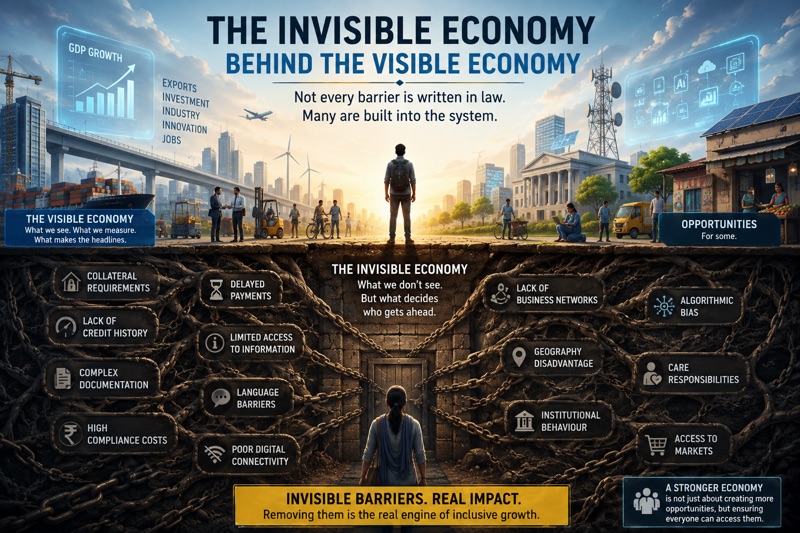
The Economy We Measure Is Not the Economy That Decides


When economists discuss growth, they often focus on visible indicators such as GDP, exports, industrial output, investment, or stock market performance. These numbers are important because they tell us what has already happened. But beneath every visible economy lies another economy that is rarely measured and almost never discussed. This invisible economy does not produce goods or services. Instead, it quietly decides who gets opportunities and who does not. It shapes who receives credit, who finds customers, who gets reliable information, who builds trusted networks, and who is able to survive difficult times. In many ways, this unseen economy has become more powerful than the formal economy itself.
Invisible Barriers Are More Powerful Than Visible Restrictions

History reminds us that economic barriers were once easy to identify. Governments imposed licensing systems, trade restrictions, quotas, and legal discrimination. As economies opened and regulations became more transparent, many believed that equal opportunity had finally arrived. Yet the nature of exclusion did not disappear. It simply became less visible. Today, there may be no law preventing a young entrepreneur from starting a business, a woman from entering the workforce, an MSME from exporting, or a farmer from reaching national markets. However, hidden obstacles often achieve exactly the same outcome. A lack of collateral blocks access to finance. Complicated documentation discourages formal participation. Delayed payments drain working capital. Poor digital connectivity isolates rural producers. Language barriers limit access to information. Algorithms reward those who are already visible while ignoring those who are not. The result is exclusion without anyone openly admitting that exclusion exists.

Opportunity Is Increasingly Controlled by Invisible Systems

Modern economies are becoming highly dependent on digital platforms, automated decision-making, financial scoring, and institutional processes. These systems promise neutrality because they rely on data rather than human judgement. Yet data itself reflects existing inequalities. Businesses with long financial histories receive easier credit. Companies with established online visibility gain more customers. Individuals with stronger networks hear about opportunities first. Regions with better infrastructure attract more investment. The invisible economy therefore reinforces the advantages of those who are already ahead, while making it increasingly difficult for newcomers to catch up.

The Hidden Cost Paid by MSMEs

For millions of micro, small, and medium enterprises, the biggest challenge is often not competition but access. They struggle to secure affordable finance because they lack sufficient collateral. They lose valuable time dealing with compliance requirements that larger firms manage through specialised departments. Payments are delayed by buyers with stronger bargaining power, creating severe cash-flow pressures. Digital marketplaces promise wider reach but frequently favour businesses with stronger marketing budgets, higher ratings, or greater visibility. Many MSMEs are not defeated by poor products or weak entrepreneurship. They are defeated by invisible systems that silently increase the cost of doing business.

Women Carry an Economic Burden That Rarely Appears in Statistics

One of the most overlooked parts of the invisible economy is unpaid care work. Millions of women contribute enormous economic value by caring for children, elderly family members, and households, yet this work is rarely recognised in national accounts. Time spent on unpaid responsibilities limits opportunities for education, entrepreneurship, formal employment, and skill development. Even where equal employment laws exist, unequal responsibilities continue to produce unequal economic outcomes. The invisible economy therefore influences labour markets as much as education, finance, and technology.

Geography Has Become an Economic Identity

A person’s location increasingly determines economic opportunity. Entrepreneurs operating in metropolitan cities gain easier access to investors, skilled workers, logistics, digital infrastructure, and business networks. Rural producers may have quality products but struggle with transportation, warehousing, branding, certification, and market information. Technology has reduced some geographical barriers, yet many digital services still depend on physical infrastructure, reliable internet, financial access, and institutional support. Economic inclusion remains deeply connected to geography, even in the digital age.

Institutions Can Open Doors or Quietly Close Them

Economic progress depends not only on policies but also on how institutions behave. The same regulation may encourage one entrepreneur while discouraging another, depending on how efficiently it is implemented. Delays in approvals, inconsistent interpretation of rules, excessive paperwork, and fragmented administrative processes increase uncertainty. These hidden transaction costs are rarely visible in official statistics, yet they reduce investment, discourage innovation, and slow economic growth. Institutional behaviour often becomes an invisible tax on productive enterprise.

The Future May Be Driven by Invisible Inequality

The next generation of economic inequality may not be defined primarily by income or wealth. It may be determined by access to trustworthy data, digital identity, artificial intelligence, financial history, professional networks, quality education, and institutional credibility. As AI becomes central to finance, recruitment, healthcare, education, and business decisions, invisible biases embedded in data and algorithms could quietly shape economic destinies. Nations that fail to recognise these hidden barriers may discover that technological progress has made exclusion more efficient rather than less.

Making the Invisible Economy Visible

Economic reform cannot stop at removing formal restrictions. Governments, financial institutions, technology platforms, industry associations, and civil society must identify and reduce the invisible barriers that prevent capable individuals and businesses from participating fully in the economy. Better access to finance, faster payment systems, simpler compliance, stronger digital inclusion, transparent algorithms, affordable childcare, improved logistics, and accountable institutions are no longer social welfare measures. They are economic necessities for sustained growth and national competitiveness.

The greatest economic challenge of the coming decades may not be creating more opportunities. It may be ensuring that opportunities are genuinely accessible. A nation can proudly display impressive growth figures, modern infrastructure, and expanding industries, yet still leave millions standing outside the real gates of prosperity. The visible economy may tell the story of production and wealth, but the invisible economy decides who is allowed to become part of that story. The countries that recognise and dismantle these unseen barriers will build not only faster-growing economies but also stronger, more resilient, and more inclusive societies.

#Economy #InclusiveGrowth #MSME #Entrepreneurship #EconomicDevelopment #PublicPolicy #ArtificialIntelligence #DigitalEconomy #India #Leadership


Wednesday, August 5, 2026

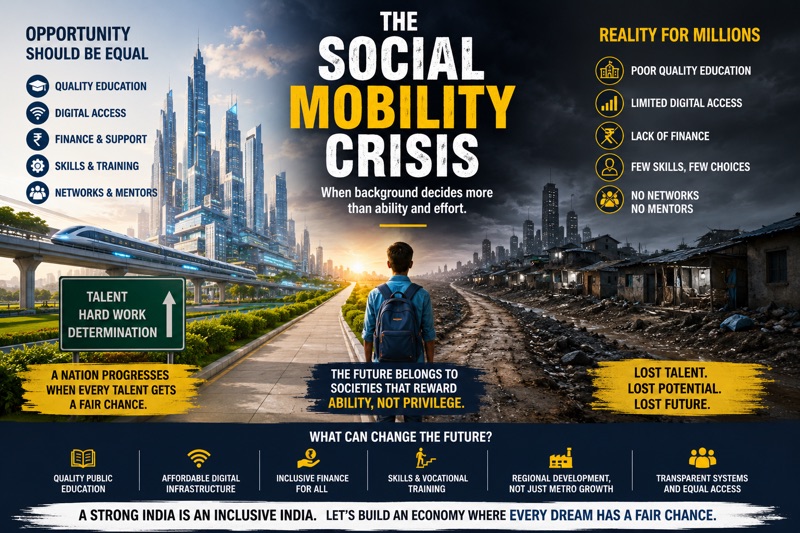
When Hard Work Is No Longer Enough


Every society survives on one powerful belief that tomorrow can be better than today. People work harder, educate their children, take risks, and build businesses because they believe effort will change their future. But when success begins to depend more on where a person is born than on what a person can achieve, that belief slowly disappears. The Social Mobility Crisis is not simply about inequality. It is about the slow disappearance of hope. History shows that civilizations grow when talent finds opportunity. They decline when opportunity becomes the privilege of a few families, a few cities, or a few powerful networks.

The New Divide Is Becoming Invisible

India has created millions of opportunities through economic reforms, digital technology, entrepreneurship, and infrastructure. Yet these opportunities are not reaching everyone equally. A child born in a metropolitan city often has access to better schools, faster internet, skilled teachers, stronger professional networks, internships, and financial support. Another child with the same intelligence in a remote village or small town may never receive the same chance. The difference is no longer only income. It is access. Access to quality education, English language skills, digital technology, finance, mentors, and influential social circles has become a new form of economic capital. Those who already have these advantages continue to move ahead, while others struggle to catch up.

Talent Is Everywhere But Opportunity Is Not

India has one of the youngest populations in the world. Every year millions of young people enter the workforce with dreams of creating a better life. Yet many remain trapped because their education does not match industry needs, financial institutions hesitate to support first-generation entrepreneurs, and hiring often depends on networks rather than capability. This creates an economy where hidden talent remains undiscovered. Every engineer without practical skills, every entrepreneur without funding, and every student without digital access represents lost national productivity. The country is not running out of talent. It is failing to connect talent with opportunity.

Technology Can Unite Or Divide

Digital India has transformed governance and business, but technology can also widen social gaps. Artificial intelligence, automation, and digital platforms reward those with advanced skills while leaving behind those who lack connectivity or digital literacy. Tomorrow, the gap may not be between rich and poor alone. It may be between those who can work with intelligent machines and those who cannot. Without universal digital capability, technological progress could unintentionally create a permanent economic divide.

Entrepreneurship Cannot Grow Without Equal Access

Every successful economy creates pathways for ordinary people to become extraordinary entrepreneurs. But when finance, market access, and business networks remain concentrated among a limited group, innovation suffers. Thousands of small businesses fail not because their ideas are weak but because they cannot reach investors, customers, or mentors. A nation where only a few people can afford to take risks gradually loses its entrepreneurial energy. Economic growth then becomes concentrated instead of inclusive.

The Cost Of Ignoring Social Mobility

If social mobility continues to weaken, the consequences will reach far beyond economics. Young people may lose faith in education. Families may stop believing that effort changes destiny. Migration toward a few large cities may accelerate while smaller towns continue to fall behind. Social frustration may increase even during periods of economic growth because people judge progress not only by national income but also by their own opportunity. Growth without mobility eventually creates instability because prosperity appears unfairly distributed.

The Future Will Be Built By Opportunity, Not Privilege

The next stage of India’s development will depend less on how much wealth the country creates and more on how widely opportunity is shared. Quality public education, affordable digital access, stronger vocational training, inclusive financial systems, regional industrial development, and transparent recruitment can rebuild confidence that ability matters more than background. The countries that lead the coming decades will not necessarily be those with the richest citizens. They will be those that discover and develop the largest amount of hidden human talent.

The greatest economic resource of any nation is not its minerals, factories, or technology. It is the confidence of its people that their future is still in their own hands. If that confidence disappears, the economy may continue to grow on paper, but its social foundation will quietly begin to weaken. The real measure of a developed nation is not how many billionaires it creates. It is how many ordinary people are able to transform their lives through talent, determination, and fair opportunity.

#SocialMobility #India #EconomicDevelopment #InclusiveGrowth #Education #DigitalInclusion #Entrepreneurship #MSME #FutureOfWork #EconomicPolicy


Tuesday, August 4, 2026

The New Fortresses of Economic Power

Data Centres as Strategic National Infrastructure

For most of modern history, countries measured their strength through fertile land, natural resources, ports, highways, power plants, and factories. Whoever controlled these assets shaped trade, production, and prosperity. In the twenty-first century, another form of infrastructure has quietly joined this list. It does not produce steel, grow crops, or transport goods. It stores, processes, and protects data. Data centres are no longer just buildings filled with servers. They are becoming the digital factories of the modern economy, and the countries that understand this shift early will shape the next era of global power.

The Invisible Infrastructure Behind Every Digital Economy

Every digital payment, online purchase, AI model, hospital record, factory sensor, government service, satellite image, and financial transaction eventually passes through a data centre. As artificial intelligence expands into manufacturing, healthcare, education, agriculture, defence, logistics, and public administration, the amount of data generated every day is growing at an unprecedented speed. This means that economic growth is becoming increasingly dependent not only on roads and electricity but also on secure computing capacity. A nation that cannot build enough digital infrastructure may eventually struggle to support its own digital economy.

From Economic Asset to National Security

History has shown that countries dependent on others for critical infrastructure often face strategic vulnerabilities. The same lesson now applies to digital infrastructure. If sensitive government records, financial systems, defence applications, healthcare databases, or industrial information are processed outside national control, questions of sovereignty become unavoidable. Future geopolitical competition may not only involve shipping routes or energy supplies but also cloud infrastructure, semiconductor capacity, cybersecurity, and data storage. The control of computing power may become as strategically important as the control of oil reserves once was.

India’s Digital Ambition Needs a Digital Backbone

India has become one of the world’s largest digital societies. Hundreds of millions of people use digital payments, online government services, e-commerce platforms, telemedicine, education technology, and rapidly expanding AI applications. Every new digital service increases demand for reliable computing infrastructure. If India aims to become a global AI leader, a manufacturing powerhouse, and a trusted digital economy, it must invest not only in software talent but also in world-class data centres, renewable energy integration, advanced cooling technologies, cybersecurity capabilities, and high-speed fibre connectivity. Digital ambition without digital infrastructure will eventually face physical limits.

The Energy and Water Challenge

The expansion of data centres also creates difficult policy choices. Large facilities consume enormous quantities of electricity while many cooling systems require substantial water resources. As AI workloads become more complex, these demands will continue to rise. Countries may soon face competition not only for investment but also for power generation, clean energy, land availability, and water security. Future industrial policies will have to balance digital growth with environmental sustainability. Otherwise, digital expansion could unintentionally create pressure on already stressed natural resources.

The New Geography of Economic Development

Data centres are beginning to influence where industries choose to invest. Regions with reliable electricity, strong fibre networks, skilled professionals, renewable energy, stable regulations, and efficient local governance are becoming attractive destinations for digital investment. This creates an entirely new geography of economic development. States and cities that prepare today may become tomorrow’s AI hubs, while those that ignore digital infrastructure could lose investment even if they possess traditional industrial strengths. The competition is no longer only between countries but also between cities capable of supporting the digital economy.

The Policy Coordination Challenge

Building a successful data centre ecosystem requires far more than constructing large buildings. It demands coordination across energy policy, telecommunications, urban planning, environmental regulation, cybersecurity, taxation, education, semiconductor strategy, and industrial policy. If these areas evolve independently, projects may face delays, higher costs, regulatory uncertainty, and infrastructure bottlenecks. The success of digital infrastructure will increasingly depend on how effectively governments coordinate institutions rather than how many policies they announce.

The AI Era Will Reward Computing Capacity

Artificial intelligence is changing the economics of computing itself. Nations with greater access to advanced computing infrastructure will train better AI systems, process larger datasets, develop stronger innovation ecosystems, and attract global investment. Computing capacity is becoming a productive asset much like capital equipment was during the Industrial Revolution. Countries that underestimate this transition may find themselves importing not only AI technologies but also the strategic capabilities that accompany them.

The Next Infrastructure Race

The coming decades may witness a transformation similar to the railway revolution of the nineteenth century or the highway expansion of the twentieth. Then, connectivity determined economic opportunity. Today, digital connectivity and computing infrastructure will increasingly determine competitiveness. The race will not simply be about building more data centres but about creating resilient, secure, energy-efficient, and nationally trusted digital ecosystems that support innovation while protecting sovereignty.

The Real Question

The real question is no longer whether countries need data centres. The real question is whether governments still view them as ordinary commercial real estate or recognise them as strategic national infrastructure. Those that continue treating data centres as just another private investment may discover too late that the world’s most valuable economic asset is no longer land beneath the factory, but the intelligence flowing through the servers inside it. In the AI-driven economy, nations that own their digital backbone will have greater control over innovation, resilience, and long-term prosperity. Those that do not may remain connected to the digital world but increasingly dependent on infrastructure they neither own nor fully control.

#DataCentres #ArtificialIntelligence #DigitalInfrastructure #NationalSecurity #India #CloudComputing #DigitalEconomy #EconomicDevelopment #Innovation #FutureOfWork


Monday, August 3, 2026

India Is Not Running Out of Infrastructure.

 It Is Running Out of the Ability to Preserve It

Every nation dreams of building something that lasts. Roads, bridges, railways, airports, industrial parks, water pipelines, schools, hospitals, and public buildings are celebrated as symbols of development. They become political milestones, attract media attention, and often define the legacy of governments. Yet history teaches a different lesson. Civilizations rarely collapse because they stopped building. They decline because they stopped maintaining what they had already built. The Roman roads, ancient Indian irrigation systems, and many historical trade routes survived for centuries because maintenance was treated as a continuous responsibility rather than an occasional repair exercise. Modern economies often forget this basic principle.

India today stands at a remarkable stage of infrastructure expansion. Expressways are connecting regions, metro systems are transforming cities, industrial corridors are expanding manufacturing, and logistics networks are improving competitiveness. This transformation deserves recognition. However, beneath this impressive growth lies a silent economic weakness that receives far less attention. The country has become increasingly successful at creating new assets but remains far less successful at protecting the value of existing ones. Maintenance is rarely celebrated, rarely rewarded, and too often postponed until systems begin to fail.

The Economics of Neglect

Infrastructure does not fail overnight. It ages quietly. Small cracks become damaged roads. Minor leakages become water shortages. Poor drainage becomes flooding. Weak electrical systems become power failures. Buildings develop structural problems long before they become dangerous. Every year that preventive maintenance is delayed, repair costs multiply. Economists have repeatedly shown that spending a small amount regularly to maintain public assets is far cheaper than rebuilding them after years of neglect.

Unfortunately, maintenance rarely generates immediate political visibility. A repaired drainage network attracts little public attention compared to the inauguration of a new highway. A well-maintained industrial estate is considered ordinary even though it quietly supports thousands of businesses every day. As a result, budgets often prioritize new construction while existing infrastructure slowly loses efficiency and value.

When Public Assets Become Economic Liabilities

Every neglected public asset creates hidden costs for the economy. Damaged roads increase fuel consumption, vehicle repairs, travel time, and logistics costs. Poorly maintained water systems waste millions of litres through leakages while industries struggle with water shortages. Weak public buildings require emergency repairs that are far more expensive than routine upkeep. Industrial estates with broken roads, unreliable utilities, and deteriorating common facilities gradually lose their attractiveness for investors.

The consequences extend beyond government finances. Businesses experience higher operating costs. Investors question long-term reliability. Citizens lose confidence in public services. Over time, infrastructure that was once expected to increase productivity begins to reduce it.

Industrial Competitiveness Depends on Maintenance

India aims to become a global manufacturing hub, but manufacturing competitiveness depends on much more than building new industrial parks. Factories require dependable roads, uninterrupted water supply, reliable electricity, efficient drainage, functioning waste management systems, and well-maintained logistics infrastructure. Even highly productive firms struggle when surrounding public infrastructure deteriorates.

Many industrial estates across the country illustrate this contradiction. Modern factories operate beside damaged internal roads, inadequate drainage, poorly maintained common facilities, and aging utility networks. The productivity of private investment becomes limited by the quality of public maintenance. The result is lower competitiveness despite substantial capital investment.

Climate Change Is Making Maintenance More Important Than Construction

The coming decades will test infrastructure in ways previous generations never experienced. Higher temperatures, extreme rainfall, floods, heat waves, rising sea levels, and unpredictable weather patterns will increase stress on roads, bridges, railways, ports, water systems, and urban infrastructure. Infrastructure built for yesterday’s climate may not survive tomorrow’s environmental realities.

Maintenance will therefore become an adaptation strategy rather than merely an engineering activity. Smart monitoring, predictive maintenance, resilient construction materials, and continuous inspection will determine whether infrastructure survives increasingly frequent climate shocks. Countries that ignore this reality may discover that rebuilding after repeated disasters becomes economically impossible.

The Future Economy Will Reward Those Who Protect Their Assets

Artificial intelligence, sensors, drones, satellite monitoring, and digital twins are changing the way infrastructure is managed across the world. Instead of waiting for failures, governments can now identify problems before they become visible. Predictive maintenance reduces costs, extends asset life, improves safety, and minimizes service disruptions. The future will not belong to countries that simply build faster. It will belong to those that maintain smarter.

India has an opportunity to become a global leader in infrastructure management by integrating digital technologies with engineering expertise. This requires maintenance budgets to become mandatory rather than discretionary, asset registers to become transparent, performance audits to include asset condition, and local governments to develop professional maintenance capabilities instead of relying only on emergency repairs.

The Real Measure of Development

The next phase of India’s economic journey will not be judged only by how many kilometres of roads are built or how many new projects are announced. It will be judged by how long these assets continue to deliver value. Infrastructure is not an event. It is a living system that demands constant care. Ignoring maintenance creates an invisible debt that future generations must eventually repay with higher taxes, slower growth, and declining public services.

A nation that builds without maintaining is not creating wealth. It is only postponing deterioration. The strongest economies of the future will not necessarily be those that build the most impressive infrastructure. They will be those that understand a timeless economic truth: preserving public assets is often more valuable than creating new ones. Sustainable prosperity will belong to countries that treat maintenance not as a recurring expense, but as one of the highest-return investments they can ever make.


#Infrastructure #India #EconomicGrowth #PublicInvestment #UrbanDevelopment #IndustrialDevelopment #InfrastructureMaintenance #ClimateResilience #MSME #FutureEconomy


Sunday, August 2, 2026

Development Is Measured by Outcomes, Not Budgets


Every government proudly announces new schemes, larger budgets, and ambitious infrastructure projects. Yet the real question is rarely asked. Has the quality of public services actually improved? A nation does not become prosperous simply because more money is allocated. It becomes prosperous when a child receives quality education, when a patient gets timely healthcare, when roads and public transport reduce travel time, when sanitation protects public health, and when government offices solve problems instead of creating them. Public service quality is not a welfare issue alone. It is one of the strongest foundations of economic growth. History shows that countries that transformed themselves into advanced economies did not rely only on industries and investments. They first built reliable institutions that consistently delivered quality services to every citizen.

The Invisible Gap Behind Economic Growth

India has made remarkable progress in expanding roads, digital governance, electricity access, financial inclusion, and public infrastructure. Yet beneath this progress lies an uncomfortable reality. The quality of essential public services differs dramatically from one state to another, one city to another, and even from one district to the next. A child born in one district may receive excellent schooling, while another child only a few hundred kilometres away struggles with poor classrooms, teacher shortages, and weak learning outcomes. Healthcare, transport, sanitation, drinking water, and administrative efficiency show similar variations. This uneven quality quietly creates unequal opportunities long before people enter the job market. Economic inequality often begins with unequal public services rather than unequal incomes.

The Cost That Families Quietly Bear

When public services fail to meet expectations, families are forced to spend their own money to compensate. Parents pay for private schools because they fear poor learning outcomes. Families depend on expensive private hospitals because public healthcare cannot always meet demand. People purchase water purifiers, private transport, backup electricity, and private security to replace services that should have been available to everyone. These hidden costs slowly reduce household savings and increase financial pressure. The burden falls most heavily on lower-income families, who spend a larger share of their income simply to obtain basic services. What appears to be economic growth on paper can become financial stress inside households.

Public Service Is Becoming the New Economic Infrastructure

The next stage of economic competition will not be decided only by industrial parks or investment incentives. Investors increasingly evaluate whether cities offer skilled workers, efficient hospitals, clean environments, reliable transport, predictable administration, and good urban services. Companies choose locations where employees can live productive and healthy lives. Talent also migrates towards places offering better quality of life. In the future, high-quality public services will become as important as highways, ports, airports, and industrial corridors. Regions that fail to improve service quality may struggle to attract investment despite offering lower business costs.

Technology Alone Cannot Repair Weak Institutions

India has made impressive progress in digital governance through online services, digital payments, and technology-enabled administration. These innovations have improved transparency and reduced many traditional barriers. However, technology cannot replace capable institutions. An online system cannot compensate for poor schools, understaffed hospitals, weak municipal management, or delayed administrative decisions. Artificial intelligence can process information faster, but it cannot replace accountability, leadership, trained professionals, or responsive governance. The future will reward governments that combine digital innovation with stronger institutions rather than treating technology as a substitute for institutional reform.

The Risk of Two Different Indias

If present trends continue, India could gradually develop into two very different economies. One India will consist of cities and regions with high-quality public services, skilled workers, better health, efficient governance, and strong investment. The other will continue struggling with poor education, inadequate healthcare, weak sanitation, administrative delays, and limited economic opportunities. Such a divide will encourage migration, widen regional inequality, increase pressure on urban infrastructure, and deepen social dissatisfaction. Over time, economic growth may become concentrated in only a few successful regions while others fall further behind.

Quality Governance Will Define India’s Future

The coming decades will not simply be shaped by how much governments spend but by how effectively every rupee is converted into better public outcomes. Nations that consistently improve service quality build healthier citizens, more productive workers, stronger businesses, and greater public trust. Those that focus only on expenditure without improving delivery risk wasting valuable resources while leaving development incomplete. India’s next economic transformation will depend less on announcing new programmes and more on ensuring that every school teaches well, every hospital heals effectively, every public office functions efficiently, and every citizen experiences governance that is reliable, fair, and accountable. In the future, the true measure of national strength will not be the size of government spending but the quality of public services that people receive every single day.

#India #PublicServices #Development #Governance #Education #Healthcare #EconomicGrowth


Saturday, August 1, 2026

The Real Crisis Is Not Food Shortage. It Is Food Uncertainty.


For decades, nations feared famine because they did not produce enough food. Today, the challenge has changed. Many countries produce sufficient food in good years, yet millions continue to struggle because food prices move like financial markets. One season tomatoes become so expensive that families stop buying them. A few months later farmers are forced to dump the same crop on roads because prices collapse below production costs. The crisis is no longer about the availability of food. It is about the inability to keep food affordable for consumers while ensuring fair returns for producers.

India represents this contradiction more clearly than many other economies. It is one of the world’s largest producers of cereals, fruits, vegetables, milk and spices, yet food inflation repeatedly becomes a national concern. At the same time, thousands of farmers continue to face financial distress because market prices often fail to cover their costs. The same system that produces expensive food for consumers can simultaneously produce poor incomes for farmers. That is the paradox that deserves greater attention.

Food Markets Are Becoming More Fragile

Historically, food prices moved gradually because agriculture was largely local and seasonal. Today the food economy is connected to climate change, global trade, energy costs, logistics, digital platforms and government policy. A flood in one state, a drought in another, rising fuel prices, restrictions on exports or disruptions in transport can all influence prices within days. Food has become part of a highly interconnected economic system where one disturbance spreads rapidly across markets.

India has improved agricultural production significantly over the past decades, but storage infrastructure, cold-chain capacity, processing facilities and integrated logistics have not expanded at the same pace. As a result, shortages and surpluses often exist simultaneously in different parts of the country. Instead of balancing markets, these weaknesses amplify price swings.

Weather Is Becoming an Economic Risk

Climate change is no longer only an environmental issue. It has become a direct economic challenge. Rising temperatures, irregular monsoons, heat waves, floods and changing pest patterns are reducing predictability in agriculture. Farmers are finding it increasingly difficult to estimate production, while governments struggle to anticipate market shortages.

The future may witness agriculture becoming less predictable every year. Instead of one poor harvest every decade, extreme weather could become a regular feature. This would make food price volatility a permanent economic condition rather than an occasional disruption. Countries that fail to build climate-resilient agriculture may experience repeated cycles of inflation and farmer distress.

Supply Chains Decide Prices More Than Farms

Many people assume that food prices are determined only by production. In reality, prices are increasingly shaped by everything that happens after harvest. Poor roads, inadequate warehouses, limited cold storage, fragmented transport systems and multiple intermediaries often increase costs before food reaches consumers.

India has invested heavily in infrastructure, yet significant gaps remain in connecting farms with modern markets. Every delay increases spoilage, reduces quality and creates artificial shortages. Improving logistics may become as important as increasing agricultural production itself. The next agricultural revolution could take place not only on farms but also in warehouses, transport networks and digital marketplaces.

Policy Cannot Keep Chasing Prices

Governments often respond to rising food prices through export restrictions, stock limits or emergency market interventions. These measures may provide temporary relief but can also create uncertainty for producers and investors. Farmers hesitate to invest when policies change frequently, while businesses become cautious about expanding storage, processing or exports.

The future requires moving from reactive policy to predictable policy. Markets perform better when governments provide stable rules, transparent information and long-term confidence rather than frequent emergency responses.

The Hidden Cost Is Nutrition

Food inflation affects far more than household budgets. It influences nutrition, education and long-term public health. When nutritious food becomes expensive, families often shift towards cheaper and less balanced diets. Children may receive fewer proteins, fruits and vegetables, while adults reduce food quality to manage household expenses.

This silent nutritional decline creates costs that appear years later through poor health, lower productivity and reduced human capital. Food price volatility therefore becomes both an economic and a social challenge.

Data May Become the New Irrigation

The next transformation in agriculture may not be driven solely by larger farms or better seeds. It may come from information. Artificial intelligence, satellite monitoring, digital crop forecasting, real-time market intelligence and predictive weather systems could help governments, traders and farmers anticipate shortages before they become crises.

Countries that combine technology with strong agricultural institutions will likely experience greater price stability. Those that ignore digital intelligence may continue reacting after markets have already become unstable.

Stability Will Become More Valuable Than Production

The future of agriculture will not be judged only by how much food a country produces. It will increasingly be judged by whether families can afford healthy food throughout the year and whether farmers can earn stable incomes despite changing weather and volatile markets.

The Food Price Volatility Crisis reminds us that agriculture is no longer simply about cultivation. It is about economics, climate resilience, logistics, technology, governance and trust working together. Nations that build resilient food systems will strengthen both economic stability and national security. Those that continue treating every price shock as an isolated event may discover that the greatest threat is not the lack of food, but the growing unpredictability of its price.


#FoodSecurity #Farmers #India #FoodInflation #Agriculture #ClimateChange #Economy #Future #SupplyChain #Development


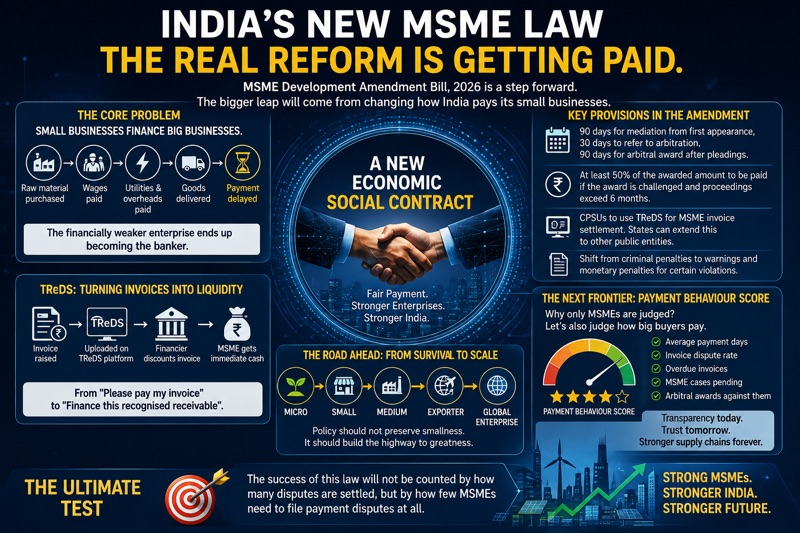
India’s New MSME Law: A Payment Reform or the Beginning of a Different Small-Business Economy?

India has spent decades telling small businesses to become competitive. Perhaps it is finally beginning to ask a more uncomfortable question...