Tuesday, September 29, 2026

When Profits Are Equated with Patriotism: The Dangerous Comfort of Domestic Capital

From FII Dependence to the Domestic Cushion

For much of India’s post-liberalisation history, foreign institutional investment was treated almost as a certificate of economic confidence. When FIIs bought Indian equities, the narrative was that global capital believed in India. When they sold, policymakers, markets and the media worried about instability. Something important has changed. India has built a much deeper domestic investor base through mutual funds, systematic investment plans, insurance, pension savings and direct retail participation. This is a major structural achievement. But it also creates a new danger: the belief that domestic money can indefinitely substitute for foreign capital, irrespective of valuation, taxation, global competitiveness or market returns.

That assumption deserves much greater scrutiny.

The Eight-Week Question

As of 25 September 2026, the Sensex and Nifty had actually completed seven consecutive negative weeks, their longest such sequence in about six years. On 28 September, both indices fell sharply again; if weakness persists through the week, it would become the eighth consecutive weekly decline. So the eighth negative weekly close has not yet been completed. (The New Indian Express)

More important than the number of weeks is what is happening underneath the indices. Foreign portfolio investors withdrew about ₹17,131 crore from Indian equities in September through the latest reported period. Another data compilation put foreign institutional selling at about ₹18,531 crore against approximately ₹52,617 crore of domestic institutional buying during September. (Akashvani News)

This is the remarkable feature of the present market: domestic capital is absorbing a substantial part of foreign selling, yet the market is still struggling.

That deserves more attention than the headline index itself.

The Domestic Investor Has Become the Shock Absorber

Historically, emerging markets feared what was sometimes called sudden-stop economics: foreign capital entered rapidly during periods of global liquidity and departed equally rapidly when interest rates, currencies or perceptions of risk changed.

India has partially reduced this vulnerability by creating its own pool of financial capital. That is unquestionably valuable. A country of India’s size should not require foreign portfolio managers to determine the price of its productive assets.

But resilience can quietly become complacency.

If policymakers begin assuming that households will continue putting money into mutual funds and markets regardless of relative returns, valuations or taxation, domestic investors cease being merely investors. They become the unofficial shock absorbers of the financial system.

There is a fundamental economic difference between the two roles.

An investor provides capital because expected risk-adjusted returns are attractive. A shock absorber provides capital because the system expects that money to keep arriving.

Patriotism Cannot Become an Asset-Pricing Model

This leads to an uncomfortable question: when does financial participation begin to be confused with economic patriotism?

Domestic investors are sometimes implicitly encouraged to think differently from foreign investors. Foreign capital can move to New York, London, Singapore, Tokyo or another emerging economy when relative returns change. Indian households, meanwhile, are expected to remain committed to the domestic growth story.

But capital does not acquire a different economic logic merely because its owner is Indian.

A retired employee investing pension savings, a salaried worker making a monthly SIP and a small entrepreneur putting surplus money into equities are not providing development assistance to the economy. They are allocating savings.

They deserve returns commensurate with risk.

Patriotism may influence consumption or national sentiment. It cannot permanently replace price discovery.

Taxation and Capital: The Story Is More Complicated

The taxation argument also needs precision. India raised the tax burden on certain capital gains in 2024: for example, the long-term capital-gains rate applicable to specified listed securities increased to 12.5% for transfers from 23 July 2024. (Etds)

But the current policy direction cannot simply be described as India continuously imposing additional taxes on foreign portfolio investors. In 2026, the government moved in the opposite direction in an important part of the capital market: it exempted qualifying FPI income from interest and capital gains on Indian government securities from income tax from 1 April 2026 and announced measures intended to facilitate foreign portfolio investment. (Press Information Bureau)

That makes today’s situation more interesting.

The larger issue is therefore not simply FII taxation versus domestic investors. It is whether India’s entire capital-market architecture—taxation, valuation, currency expectations, corporate earnings and regulatory predictability—remains internationally competitive.

Foreign Selling Is a Signal, Not a Verdict

It would also be misleading to attribute the present decline primarily to Indian tax policy.

Foreign selling has coincided with elevated US bond yields, expensive crude oil, geopolitical uncertainty and currency pressure. Recent market reporting identifies these global factors alongside sustained portfolio outflows as important drivers of the seven-week decline. (The New Indian Express)

Foreign investors have sold heavily over a longer period as well. Reuters reported this month that foreign investors sold nearly $45 billion of Indian equities across 2025 and 2026. (Reuters)

But FII selling should neither be worshipped nor dismissed.

Foreign capital can be short-term, momentum-driven and occasionally irrational. Yet persistent foreign selling can also be information. Global investors continuously compare India with alternative destinations on valuation, currency risk, taxation, earnings growth, liquidity and policy predictability.

The correct response to capital leaving is therefore neither panic nor nationalism.

It is diagnosis.

The Paradox of the Domestic Cushion

Imagine two markets.

In the first, foreign investors sell ₹100 and there are insufficient domestic buyers. Prices fall rapidly.

In the second, foreign investors sell ₹100 while domestic institutions buy ₹80. Prices decline much less.

Clearly, the second system is more resilient.

But now imagine this continues year after year. Foreign investors continuously reduce exposure while household savings continuously enter through institutional channels.

The apparent stability may begin concealing a deeper question:

Who is transferring risk to whom?

If foreign investors reduce positions at relatively high valuations while domestic savings continually absorb those shares, the system must eventually demonstrate that domestic buyers received adequate long-term returns.

Otherwise, financial deepening can unintentionally become financial risk redistribution—from globally mobile institutional capital toward domestically captive household savings.

That is the question India should examine before celebrating every month of record domestic inflows.

The Next Financial Revolution Must Be About Returns

India’s first capital-market revolution was foreign participation.

The second was democratisation: demat accounts, online trading, mutual funds, SIPs and millions of new household investors.

The third revolution must be more demanding.

It must be about quality of returns, governance, productivity and capital allocation.

Domestic liquidity cannot permanently compensate for weak earnings. SIP flows cannot indefinitely justify excessive valuations. Household savings cannot become an automatic buyer of last resort. And taxation cannot be designed on the assumption that investors have nowhere else to go.

Technology will make this increasingly important. Over the next decade, Indians will gain easier access to international securities, global ETFs, tokenised assets and cross-border investment platforms. Capital that appears domestically captive today may become far more internationally mobile tomorrow.

The government therefore cannot simply ask how much domestic money is entering the market.

It must ask why that money should rationally remain there.

From Atmanirbhar Capital to Competitive Capital

India certainly needs deeper domestic capital markets. An economy aspiring to become one of the world’s largest cannot remain excessively dependent on foreign portfolio flows.

But financial self-reliance should not mean financial insulation.

The strongest market is not one where domestic investors keep buying because foreign investors are leaving. It is one where domestic and international investors independently conclude that Indian productive assets offer attractive long-term returns.

That distinction will become crucial.

Foreign capital should not be treated as a master whose departure creates panic. Domestic capital should not be treated as a patriotic reserve army expected to defend market valuations.

Both should face the same fundamental economic proposition:

Is India generating enough productivity, profitability and future cash flow to justify the price investors are being asked to pay?

That is ultimately the test that no amount of liquidity can permanently avoid.

The dangerous moment begins when a country starts confusing capital-market resilience with guaranteed domestic loyalty, liquidity with productivity, and profits with patriotism.

Markets do not ultimately reward patriotism.

They reward the productive use of capital.

#IndianEconomy #StockMarket #FII #DomesticInvestors #CapitalMarkets #Investment


Monday, September 28, 2026

The New Commodity Nationalism: When Resources Refuse to Remain Raw

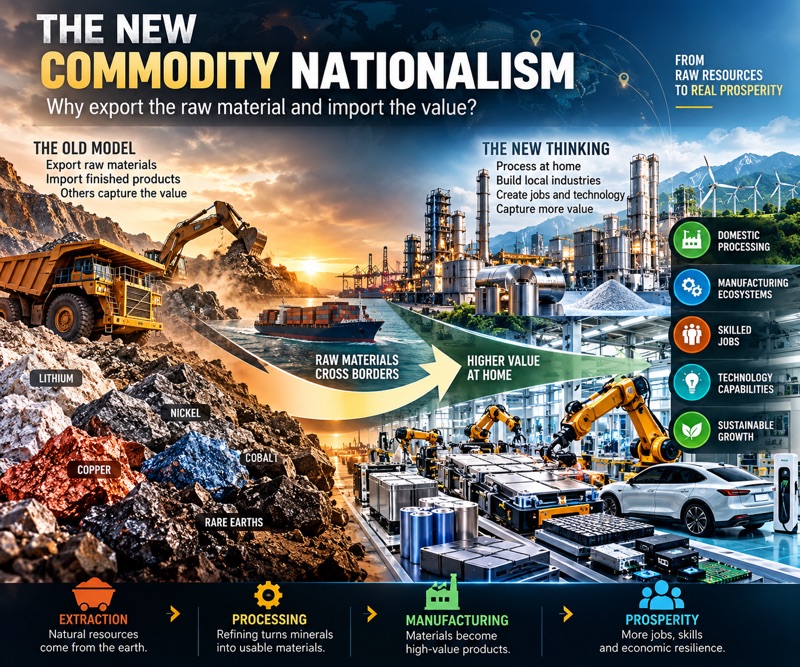
The old commodity bargain is beginning to break. For much of modern economic history, the global division of labour followed a remarkably persistent pattern: resource-rich economies extracted minerals, agricultural commodities, timber and energy, while industrial economies converted them into metals, chemicals, machinery, consumer products and sophisticated technologies. Copper could leave one country as concentrate and return embedded in electrical equipment. Cocoa could leave another as beans and reappear as branded chocolate. Lithium, nickel or cobalt could cross borders several times before becoming part of a battery whose final value was many multiples of the original mineral. The geography of extraction and the geography of value creation were rarely the same. That arrangement is now being questioned, and the challenge may reshape international trade during the next two decades.
From resource ownership to value-chain ownership. The emerging argument among resource-rich countries is simple: owning the resource but surrendering most of its downstream value is an incomplete form of economic sovereignty. Governments increasingly want mines to generate smelters, refineries, processing facilities, component manufacturers, engineering services, logistics systems, technology capabilities and skilled employment. The objective is shifting from maximizing commodity exports to maximizing the domestic economic ecosystem created around commodities. This represents a deeper change than conventional protectionism. It is an attempt to reposition countries within global value chains.

History explains the frustration. Colonial trading systems were frequently constructed around extracting commodities and supplying manufactured goods back to producing regions. Independence changed political control much faster than it changed this economic architecture. Many developing countries therefore remained heavily dependent on exporting primary commodities whose prices were determined internationally, while importing higher-value manufactured products. Earlier attempts at import substitution and state-led industrialisation tried to break this dependence, but many suffered from small domestic markets, weak technology, inefficient public enterprises and limited global competitiveness. The new commodity nationalism is emerging in a very different world—one of global supply chains, strategic minerals, electric vehicles, renewable energy, semiconductors and geopolitical competition.

The battery has changed the politics of the mine. The energy transition is turning previously ordinary mineral questions into strategic industrial questions. Lithium, nickel, cobalt, copper, graphite and rare-earth elements are not simply commodities; they are inputs into batteries, electricity networks, electronics, defence systems and advanced manufacturing. Consequently, a government looking at a mineral deposit increasingly sees something larger than export revenue. It sees the possible beginning of an industrial chain. Indonesia’s experience with nickel illustrates the logic particularly clearly: restrictions on exports of unprocessed material have been used alongside policies encouraging domestic refining and downstream investment. Whatever the debates over costs, environmental consequences and trade disputes, the strategic message has travelled widely: mineral policy can be industrial policy.

But banning exports does not manufacture competitiveness. This is where commodity nationalism faces its greatest danger. Governments can prevent a tonne of mineral from leaving the country, but they cannot legislate a globally competitive industry into existence. Processing requires electricity, infrastructure, technology, finance, environmental management, skilled workers, reliable regulation and customers. A country without these complementary capabilities can convert a natural-resource advantage into an expensive industrial bottleneck. The critical question therefore is not whether raw materials should be processed domestically. It is whether domestic processing can eventually become commercially competitive without permanent protection.

The coming contest may be over processing rather than extraction. During the twentieth century, geopolitical attention often concentrated on who controlled oilfields, mines and agricultural land. In the twenty-first century, control over the intermediate stages may become equally important. Refining lithium, separating rare earths, processing graphite, producing battery chemicals, manufacturing cathodes and anodes, refining copper and producing specialised metals can create strategic chokepoints. A country may possess mineral reserves yet remain dependent on another country for the technology required to transform them into industrial inputs. Resource security and processing security are therefore becoming different questions.

Commodity nationalism may also fragment world trade. If more governments impose export taxes, quotas, beneficiation requirements, local-content obligations or state participation, companies will have to redesign supply chains around political geography rather than simply production cost. Manufacturers may increasingly invest where resources are located because access to those resources could become conditional on local processing. Mining investment could consequently pull manufacturing investment behind it. Instead of minerals automatically travelling towards existing industrial centres, parts of industry may gradually travel towards mineral-producing economies.

A new bargaining relationship is emerging between governments and corporations. Resource-rich countries are increasingly capable of asking multinational investors a different question: not simply how much capital will you invest in extraction, but what capabilities will remain after the resource has been extracted? Technology transfer, supplier development, processing capacity, workforce skills, research facilities and domestic ownership may become central components of negotiations. The strongest resource strategies will therefore treat a mine not as an isolated project but as an anchor around which an industrial ecosystem can potentially develop.

State participation will return—but in a new form. The twentieth-century model often placed the state directly inside production through large national enterprises. The emerging model could be more hybrid. Governments may combine sovereign wealth funds, development finance institutions, public-private ventures, strategic equity stakes, production-linked incentives and infrastructure investment. The state may become shareholder, financier, regulator and strategic buyer simultaneously. This creates opportunities for patient industrial investment, but it also creates serious governance risks. When governments simultaneously regulate and own businesses, commercial discipline can weaken unless transparency and institutional accountability are exceptionally strong.

The environmental contradiction cannot be ignored. Processing more resources domestically may create employment and value addition, but refining and smelting can be highly energy-, water- and pollution-intensive. There is a danger that resource nationalism simply moves environmental damage closer to extraction communities while presenting the result as industrial development. The countries that ultimately gain most may therefore be those capable of combining minerals with renewable electricity, efficient processing technologies, recycling systems, environmental safeguards and credible traceability. In tomorrow’s commodity economy, low-carbon processing itself could become a competitive advantage.

The next stage is circular commodity nationalism. The most interesting development may eventually move beyond mines altogether. Batteries, electronics, vehicles and industrial machinery contain tomorrow’s mineral reserves. Countries that build recycling and material-recovery industries could create secondary supplies of lithium, copper, nickel, cobalt and rare earths. Resource strategy may consequently expand from controlling what comes out of the ground to controlling what comes back from the consumer. The future mineral economy could therefore be simultaneously extractive, industrial and circular.

India must think beyond securing supplies. For India, the strategic question is larger than acquiring overseas mineral assets. Long-term competitiveness will depend on connecting mineral security with refining, advanced materials, component manufacturing, recycling, research and industrial clusters. Simply replacing dependence on imported minerals with dependence on imported processed materials would move vulnerability one stage down the supply chain rather than eliminate it. The opportunity lies in building capabilities around materials themselves—metallurgy, chemistry, engineering, recycling technology, testing and specialised machinery.

The resource map may become the new industrial map. This is perhaps the most unconventional implication. Industrial geography was once shaped heavily by coalfields, ports and rivers. Globalisation then allowed manufacturing to separate increasingly from the physical location of raw materials. Commodity nationalism may partially reverse that separation. Where lithium, copper, nickel, rare earths, renewable electricity and processing infrastructure intersect, entirely new industrial centres could emerge.

The winners, however, will not necessarily be the countries possessing the largest deposits. Natural resources provide bargaining power, not automatic prosperity. The decisive advantage will belong to economies capable of converting geology into technology, technology into manufacturing and manufacturing into internationally competitive enterprises.

That distinction matters enormously. The old commodity economy asked: What resources does a country possess? The emerging economy will ask a much harder question: How much economic complexity can that country build around what it possesses?

The new commodity nationalism is therefore not ultimately about keeping minerals inside national borders. It is about keeping more knowledge, processing, technology, employment, enterprise and value there.

And that may transform the politics of globalisation itself—from a world organised around who owns the resource to one increasingly organised around who controls the value chain built upon it.


#CommodityNationalism #CriticalMinerals #GlobalEconomy #Industrialisation #Manufacturing #SupplyChains #IndustrialPolicy #India #EconomicDevelopment #FutureEconomy


Sunday, September 27, 2026

When Concrete, Cables and Corridors Become Instruments of Power

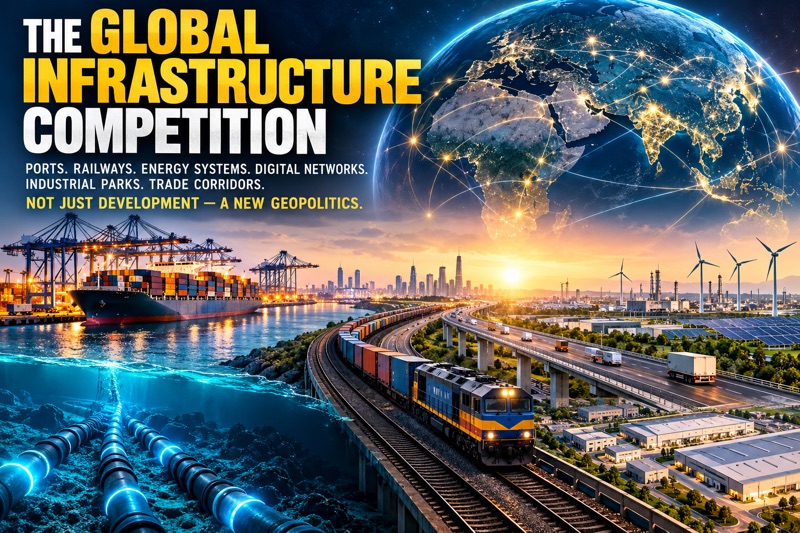
For much of modern economic history, infrastructure was treated as the plumbing of development. Governments built roads, ports, power stations and railways so that factories could produce, farmers could reach markets and cities could grow. That description is becoming dangerously incomplete. Infrastructure is no longer simply supporting the economy. It is increasingly determining who controls the geography of the future economy. A port can influence trade routes. A railway can redirect mineral flows. A power grid can create industrial dependence. A data cable can determine digital connectivity. An industrial park can anchor an entire manufacturing ecosystem. The emerging global competition is therefore not only about who produces the cheapest product. It is increasingly about who builds, finances, operates and connects the systems through which products, energy, information and capital must travel.
Infrastructure Has Always Been Political

History provides an uncomfortable reminder that infrastructure and power have rarely been separate. The Roman road network moved commerce, but it also moved armies and administration. European railway construction during the colonial period connected markets, but frequently connected them according to the requirements of imperial trade. Canals such as Suez and Panama transformed transportation economics while simultaneously becoming strategic assets. After the Second World War, highways, electricity systems, ports and development finance became central to reconstruction and industrialisation.

The twentieth-century development model therefore had a relatively simple sequence: build infrastructure, reduce transaction costs, attract investment and generate growth.

The twenty-first century is adding another layer: build infrastructure, shape connectivity, influence supply chains and acquire strategic leverage.

That difference is fundamental.

The New Geography of Power Is Being Built

Globalisation once encouraged the belief that geography was becoming less important. Containerisation, cheap shipping, telecommunications and open trade reduced the economic penalty of distance. Companies could separate design, production, assembly and distribution across continents.

But recent disruptions have exposed the limits of that model. Pandemic-era shortages, geopolitical tensions, shipping disruptions, energy insecurity and competition over critical minerals have reminded governments that a supply chain is ultimately a physical chain.

Factories need electricity. Electricity needs grids. Grids need equipment and minerals. Minerals need mines, railways and ports. Digital economies need data centres, submarine cables and reliable energy. Semiconductor plants need water, power, logistics and specialised industrial ecosystems.

The supposedly weightless global economy has rediscovered concrete, steel, electricity and geography.

This is why ports, railways, logistics parks, pipelines, transmission systems, semiconductor ecosystems and digital networks are acquiring significance far beyond their immediate commercial returns.

The Competition Is Moving from Products to Systems

Traditional industrial competition asked a straightforward question: which country can manufacture a product most efficiently?

The emerging competition asks something much larger: which country or coalition can organise the entire economic system around production?

Consider an industrial corridor. Its value does not come from a highway alone. It emerges when transport infrastructure connects with industrial nodes, ports, electricity, warehousing, customs systems, finance, skills, housing and digital networks.

The same principle applies internationally.

A port without efficient hinterland connectivity may remain an expensive piece of concrete. A railway without sufficient cargo becomes a fiscal burden. An industrial park without suppliers becomes real estate. A digital network without affordable electricity cannot create a competitive data economy.

The real strategic asset is therefore not infrastructure itself. It is connected infrastructure.

This is where global infrastructure competition becomes more sophisticated. Major economies and development institutions are increasingly interested not merely in individual projects but in corridors and ecosystems capable of reorganising trade and investment geography.

Finance Will Become the Invisible Battlefield

The most important infrastructure competition may occur before construction begins.

Infrastructure requires enormous amounts of long-term capital. Developing economies simultaneously need transport systems, renewable energy, electricity grids, urban infrastructure, water systems and digital connectivity. Their fiscal capacity is often insufficient to finance everything domestically.

This creates a strategic question: who finances the infrastructure?

The lender or investor may influence technology standards, procurement, contractors, operating structures, debt terms and sometimes the future commercial orientation of the asset.

Infrastructure finance therefore carries something ordinary trade finance rarely does: decades of institutional relationships.

A consumer product can change suppliers next year. A railway gauge, electricity architecture, port concession, telecommunications system or industrial corridor may shape economic relationships for several decades.

This is why competition among national governments, multilateral development banks, sovereign funds, private investors and development-finance institutions will intensify.

But the danger is equally important. Developing countries can easily confuse available finance with good infrastructure.

Money can build an asset. It cannot guarantee that the asset creates productivity.

The Coming Problem of Infrastructure Without Economics

The next decade may produce an extraordinary paradox: countries could simultaneously suffer from infrastructure shortages and infrastructure excess.

There may be too little infrastructure where businesses genuinely need it and too much politically attractive infrastructure where economic demand remains weak.

This distinction matters enormously.

A spectacular port with insufficient cargo is not transformation. An industrial park without firms is not industrialisation. A railway without freight economics is not connectivity. A data centre without reliable electricity is not digital sovereignty.

The obsession with project size can therefore become misleading.

The better measurement is not kilometres constructed, megawatts installed or investment announced. It is economic activity generated per unit of infrastructure investment.

That requires governments to move from construction thinking to ecosystem thinking.

Digital Infrastructure Changes the Meaning of Sovereignty

The infrastructure contest is also moving underground and into cyberspace.

Submarine cables, fibre networks, cloud infrastructure, satellite systems, data centres and telecommunications equipment are becoming the roads and ports of the digital economy.

This creates a new kind of strategic geography.

A country may possess excellent physical ports but remain digitally dependent. It may generate enormous amounts of data while relying heavily on foreign technological infrastructure to process or transmit it.

Future economic sovereignty will therefore involve at least three overlapping networks: physical connectivity, energy connectivity and digital connectivity.

Countries capable of integrating all three could become disproportionately important economic nodes.

India Cannot Win by Building Isolated Projects

This changing landscape presents India with an unusually large opportunity, but also a major policy challenge.

India sits between important economic regions: East and Southeast Asia, the Indian Ocean, the Gulf, Africa and Europe. Its domestic market, manufacturing ambitions and maritime position create the possibility of becoming a major node in emerging trade and production networks.

But geography creates opportunity only when infrastructure converts location into economic advantage.

India therefore needs to think beyond individual highways, ports and industrial parks. The more important question is whether these assets form functioning production corridors.

A port must connect efficiently with manufacturing clusters. Manufacturing clusters must connect with suppliers. Suppliers need skills, technology and finance. Logistics systems need predictable customs procedures. Exporters need certification and market intelligence. Electricity must be reliable and increasingly competitive in carbon intensity.

The corridor must become an economic organism rather than a collection of construction projects.

For MSMEs this distinction is especially important. Large corporations can sometimes build private logistics, warehousing, energy and compliance systems. Smaller enterprises cannot.

Well-designed common infrastructure can therefore reduce the structural disadvantage faced by MSMEs. Poorly designed infrastructure may simply raise nearby land prices while leaving enterprise productivity largely unchanged.

Industrial Clusters May Become the Missing Link

The future infrastructure debate should consequently move closer to cluster economics.

Imagine a transport corridor passing through ten industrial clusters. Traditional infrastructure planning may measure traffic volumes and travel times. A more advanced approach would ask what prevents firms in those clusters from entering larger value chains.

Perhaps the problem is testing facilities. Perhaps cold storage. Perhaps design capability. Perhaps worker accommodation. Perhaps digital logistics. Perhaps certification laboratories or common effluent treatment.

The next generation of infrastructure policy should connect hard infrastructure with productive capability infrastructure.

That could become particularly important for India because thousands of smaller manufacturing enterprises already exist. The challenge is not always to create economic activity from zero. It is frequently to connect existing productive capacity with better technology, logistics and markets.

The World Could Split into Competing Connectivity Systems

The more difficult future scenario is fragmentation.

If geopolitical competition intensifies, infrastructure networks themselves could begin reflecting competing economic blocs. Countries may increasingly prefer trusted telecommunications suppliers, secure energy systems, alternative payment networks, diversified shipping routes and politically reliable logistics corridors.

Globalisation would not necessarily disappear.

It could instead become multi-network globalisation.

Several partially overlapping trade, technology, energy and financial systems could coexist.

For developing countries this would create difficult choices. Joining only one infrastructure ecosystem could create dependency. Trying to participate in every ecosystem could generate incompatible standards and political pressure.

Strategic flexibility may therefore become an economic asset.

From Infrastructure Competition to Connectivity Competition

The biggest mistake would be to interpret the emerging infrastructure race simply as another construction boom.

The deeper competition concerns connectivity.

Countries will compete to become places through which goods move, electricity flows, data travels, capital circulates and production networks connect.

Some countries will build infrastructure.

Others will build economic gravity.

That distinction may define the next phase of global development.

The winning infrastructure of the future will not necessarily be the biggest port, longest railway or largest industrial park. It will be the network that creates the strongest relationships between production, technology, energy, logistics, finance and markets.

The twentieth century taught countries to build roads to development.

The twenty-first century may demand something much harder: build networks that others find economically valuable to join.

And that is why the Global Infrastructure Competition is ultimately not a competition over concrete.

It is a competition over the architecture of the future global economy.


#Infrastructure #EconomicCorridors #Geopolitics #GlobalTrade #IndustrialPolicy #India #MSME #IndustrialClusters #SupplyChains #DigitalInfrastructure #Logistics #EconomicDevelopment


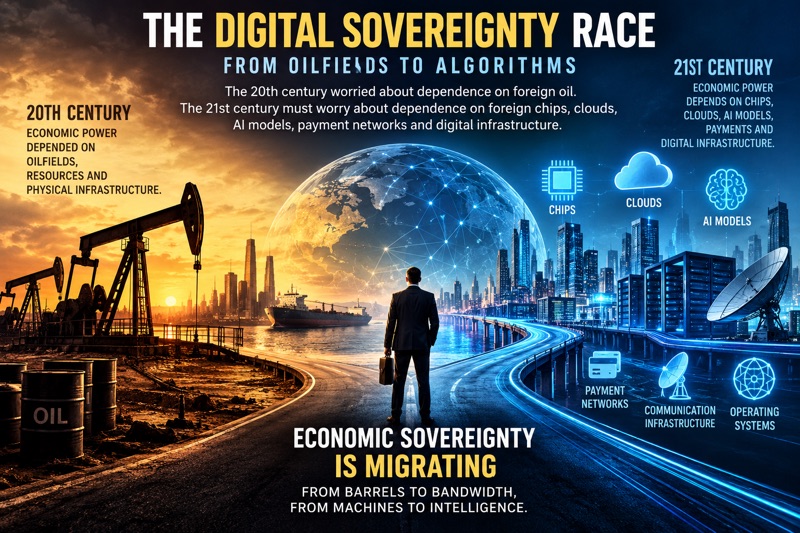
When Economic Independence Moves from Oilfields to Algorithms

The strategic resource of the twentieth century was oil. The strategic infrastructure of the twenty-first century may be computation. For ...