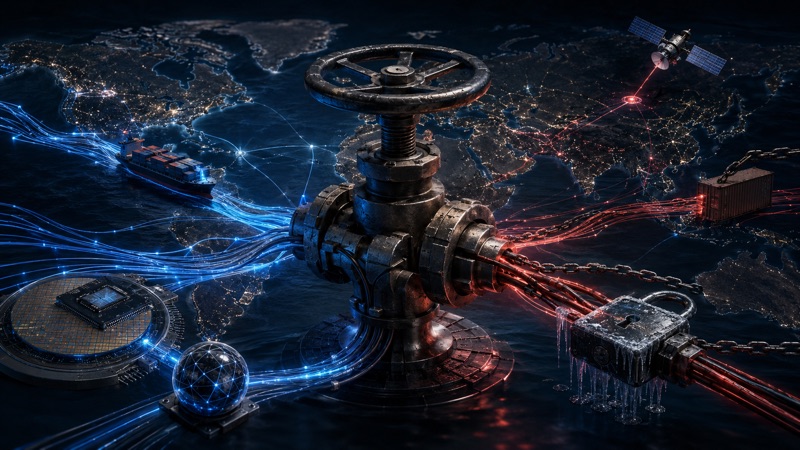
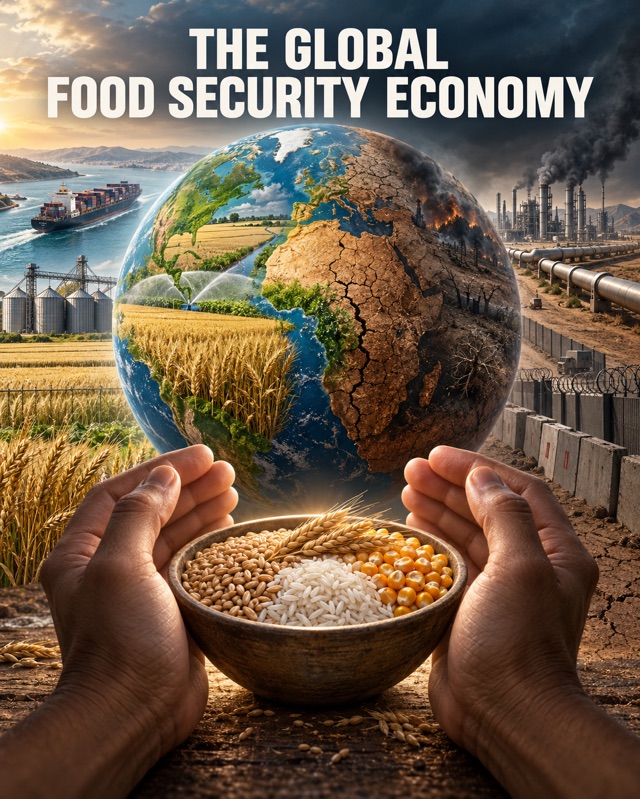
 The future of food will not be decided only on farms. It will be decided in energy markets, fertilizer factories, shipping corridors, water systems, climate negotiations, central banks and government war rooms. A bag of wheat may begin in a field, but its final price can be shaped by the cost of natural gas, a drought thousands of kilometres away, a blocked shipping route, an export ban or a sudden fall in the value of the importing country’s currency.
This is the new global food security economy. Food is becoming less like an ordinary product and more like a strategic asset. Governments once believed that open markets would move food efficiently from surplus regions to deficit regions. That belief has not completely disappeared, but confidence in it is weakening. Whenever scarcity appears, national survival begins to override global cooperation.
The result is a dangerous contradiction. Every country wants access to global food markets during a shortage, but many also want the freedom to restrict exports when their own domestic prices rise. A trading system cannot remain dependable if every government expects others to keep markets open while reserving the right to close its own gates.
History Repeats Itself Through Different Shocks
The food crises of the 1970s showed how energy prices, fertilizer costs, poor harvests and geopolitical instability could combine. The food-price shocks of 2007 and 2008 showed that export restrictions could magnify a shortage. The pandemic demonstrated how quickly countries could treat food, medicines and essential goods as matters of national security. The Russia–Ukraine war then exposed the concentration of grain, edible-oil and fertilizer supplies in a few strategic regions.
The lesson from these episodes is uncomfortable. A shortage does not need to be global to create a global crisis. Fear itself can become a market force. Importers begin buying more than they immediately need. Exporters impose controls. Traders hold stocks in expectation of higher prices. Consumers begin panic buying. A manageable supply problem is then transformed into a much larger affordability crisis.
In April 2025, the World Bank recorded 25 food-export bans across 19 countries, along with 12 additional export-limiting measures imposed by eight countries. These restrictions were designed largely to protect domestic consumers, but collectively they reduced confidence in international supply and transferred inflation to food-importing economies. World Bank Food Security Update
This pattern will return whenever governments feel politically threatened by food inflation. The instinct is understandable. Hungry citizens do not wait patiently for international markets to rebalance. But a policy that looks rational within one national border can become destructive when copied across many borders.
Hunger Is Increasingly a Problem of Access
The world produces enormous quantities of food, yet hunger persists because production is only one part of food security. Income, prices, transport, conflict, storage, nutrition and access matter just as much.
Around 645 million people faced hunger in 2025, while approximately 2.7 billion people could not afford a healthy diet. This reveals the real crisis. The problem is not simply whether calories exist somewhere in the world. The problem is whether families can afford nutritious food where and when they need it. FAO State of Food Security and Nutrition
A country can have full warehouses and still have hungry citizens. Grain reserves do not automatically become household nutrition. Subsidised rice may prevent starvation but cannot by itself provide protein, vegetables, fruit and micronutrients. Food security policies that count only tonnes of grain risk creating statistical security alongside nutritional insecurity.
This distinction will become more important. The next food crisis may not appear as empty shelves. It may appear as shrinking family diets. People will quietly shift from nutritious foods to cheaper calories. Children will consume less protein. Households will reduce meal quality before reducing meal quantity. The crisis will therefore become visible in health records long after it begins in food markets.
The Hidden Energy and Fertilizer Connection
Modern agriculture converts energy into food. Natural gas is a major input in nitrogen fertilizer. Diesel runs tractors, irrigation pumps and transport vehicles. Electricity powers cold chains, warehouses and processing plants. Shipping moves grain, fertilizers and edible oils across continents.
This means an energy shock can become a fertilizer shock, then a farm-cost shock, and finally a food-price shock. The transmission may take months, which makes the danger easy to underestimate. Farmers may initially reduce fertilizer use to protect their income. The real effect appears later through lower yields and tighter supplies.
This vulnerability became more visible again in 2026 as instability in the Middle East threatened energy, fertilizer and shipping flows. The World Bank projected an increase of about 2.5 percent in its global food commodity price index for 2026, while warning that the balance of risk remained on the upside. The significance is not the percentage alone. It is the possibility that energy, freight, fertilizer and food prices could rise together. World Bank Global Food Market Outlook
Poor food-importing countries are especially exposed. They may face higher import bills at the same moment that their currencies weaken and borrowing costs rise. Food insecurity then becomes a fiscal crisis, a debt problem and eventually a political crisis.
Climate Change Is Turning Stability into Volatility
Agriculture has always depended on weather, but climate change is altering the frequency and intensity of disruption. Heatwaves can reduce wheat yields. Irregular rainfall can damage rice cultivation. Drought can lower river levels and restrict transport. Floods can destroy crops, roads, warehouses and rural livelihoods simultaneously.
The greater risk is not one failed harvest. It is the possibility of several major producing regions facing difficulties within the same season. Global trade can compensate when one region fails and another has a surplus. It becomes much less effective when shocks are correlated.
Water will also become a hidden boundary on food production. Governments may promise greater self-sufficiency, but water-stressed countries cannot endlessly expand water-intensive crops. Producing everything domestically may look strategically attractive while being ecologically impossible.
Future food policy will therefore face a difficult choice between national self-sufficiency and resource reality. Some countries will discover that importing food is also a way of importing virtual water. Others will continue supporting unsuitable crops because changing agricultural patterns is politically harder than exhausting groundwater.
The Return of the Strategic Food State
Governments are rebuilding strategic reserves, increasing farm subsidies, supporting domestic fertilizer production and strengthening food-distribution systems. These interventions are not temporary accidents. They represent the return of the strategic food state.
Strategic reserves can protect vulnerable people and calm markets during genuine emergencies. But badly managed reserves can also distort prices, encourage waste and become politically controlled warehouses. Subsidies can protect farmers, yet poorly designed subsidies may reward excessive use of water, electricity and fertilizer. Domestic production can improve resilience, but complete self-sufficiency can become extremely costly and environmentally damaging.
The important question is therefore not whether the state should intervene. It already does. The real question is whether intervention builds resilience or merely postpones reform.
A strong food-security system requires transparent stock information, efficient storage, climate-resilient seeds, diversified imports, reliable crop insurance, better water management and targeted income support. It must protect consumers without destroying incentives for farmers. It must also distinguish between temporary emergency measures and permanent political habits.
Food Nationalism Can Create the Crisis It Fears
Food nationalism begins with a simple political message: domestic food must remain at home. In the short term, an export restriction may increase local availability and reduce political pressure. But the longer-term effects can be damaging.
Farmers receive weaker price signals and may plant less in the next season. Exporters lose customers who then search for more reliable suppliers. Investment in storage and processing slows because policy becomes unpredictable. Import-dependent countries respond by building larger reserves or subsidising domestic production, even where it is inefficient. The global food system becomes more fragmented, more expensive and less flexible.
Trade is not the enemy of food security. Unreliable trade is. International markets allow harvests from different climates and seasons to balance one another. They move food from regions of abundance to regions of scarcity. The World Trade Organization has already recognised the humanitarian danger by exempting food purchased by the World Food Programme from export restrictions. WTO Food Security Framework
However, humanitarian exemptions address only the final stage of crisis. The deeper challenge is preventing national restrictions from turning local anxiety into global scarcity.
The Future Will Belong to Resilient Food Networks
The old food economy rewarded maximum efficiency. The emerging food-security economy will reward controlled redundancy. Countries will diversify suppliers, hold larger reserves, invest in alternative fertilizers and build regional trade corridors. Companies will map climate, water, political and transport risks across their supply chains. Digital systems will monitor crops, inventories and prices more closely.
Technology will help, but it will not remove political failure. Artificial intelligence may forecast a drought, yet it cannot force governments to share information or resist panic-driven restrictions. Gene-edited crops may improve climate tolerance, but they cannot repair broken rural institutions. Vertical farming may supply selected vegetables, but it cannot cheaply replace the global production of wheat, rice and maize.
The most valuable innovation may therefore be institutional rather than technological. Countries need trusted agreements on export restrictions, reserve transparency, humanitarian access and emergency coordination. Regional food-security systems may become particularly important because neighbouring countries can share storage, transport routes and seasonal production advantages.
Food Security Is Becoming Economic Security
The central danger is that food policy may become permanently securitised. Once every crop is treated as a national-security asset, ordinary trade disagreements can become geopolitical conflicts. Wealthy countries will be able to subsidise resilience, acquire land abroad and secure long-term supply contracts. Poorer countries may be left competing in volatile spot markets with limited fiscal capacity.
This could produce a two-level global food economy. One level will consist of countries with strategic reserves, diversified suppliers, advanced technology and strong currencies. The other will consist of countries that buy food only after prices rise and sell crops early because they urgently need foreign exchange.
The future challenge is not merely to produce more food. It is to prevent food security from becoming a privilege purchased by powerful states.
The world must accept a difficult truth. No country can achieve lasting food security by making every other country less secure. National reserves are necessary. Domestic production is important. Farmers need protection. But when emergency controls become the normal language of food policy, the system begins to consume its own resilience.
Food nationalism may win an election, calm a market or lower a price for a few months. It cannot build a stable global food system. In the coming decades, the safest country will not necessarily be the one that closes itself to the world. It will be the one that combines strong domestic capacity with diversified trade, ecological discipline, reliable institutions and international cooperation.
Food is becoming an instrument of power. The real test of the future will be whether humanity uses that power to build shared security or to organise scarcity.
#FoodSecurity #Agriculture #GlobalEconomy #ClimateChange #TradePolicy #FoodInflation #EconomicSecurity #SustainableAgriculture


 When Growth Becomes a Distraction