
Historically, commodities shaped empires and wars. Colonial powers expanded globally not merely for territory but for spices, minerals, oil, and agricultural control. The oil shocks of the 1970s demonstrated how energy could destabilize entire economies within months. However, what is emerging today is even more dangerous because multiple crises are colliding simultaneously. Energy insecurity, climate instability, trade fragmentation, sanctions, and strategic stockpiling are now interacting together. Commodity markets are no longer functioning as neutral economic systems. They are becoming strategic battlegrounds.
India stands at the center of this transformation because of its deep dependence on imported commodities. Despite becoming one of the world’s fastest-growing major economies, India remains structurally vulnerable to imported energy shocks and edible oil dependency. A large share of crude oil, natural gas, fertilizer inputs, electronic minerals, and edible oils still come from global markets exposed to geopolitical risks. This means that even when domestic demand remains stable, Indian households and industries can suffer because of external disruptions completely beyond their control.
The biggest pressure continues to emerge from energy imports. India imports the majority of its crude oil requirements, making the economy highly exposed to global oil volatility. Every geopolitical conflict in West Asia immediately creates nervousness in Indian markets. Wars in oil-producing regions, sanctions on major producers, production cuts by oil alliances, and disruptions in shipping routes directly influence transport costs, inflation, and fiscal management in India. The Red Sea disruptions and wider geopolitical tensions have shown how fragile global energy transportation systems remain. Even a temporary rise in crude oil prices can increase inflationary pressure across food, logistics, manufacturing, aviation, and household consumption.
The hidden danger is that oil is no longer merely an energy commodity. It has become a geopolitical weapon. Production decisions are increasingly influenced by strategic alliances rather than market stabilization. Major oil-producing countries are now coordinating output cuts and supply management not simply for revenue optimization but also for geopolitical leverage. Energy diplomacy is becoming as important as military diplomacy. Countries that control oil flows increasingly influence global political negotiations, trade relationships, and currency stability.
India has attempted to reduce this vulnerability through diversification of import sources. The increasing purchase of discounted Russian crude after the Ukraine conflict reflects strategic pragmatism rather than ideological positioning. India has tried to balance affordability, energy security, and geopolitical neutrality simultaneously. However, diversification itself has limitations because global energy markets remain deeply interconnected. Shipping insurance, sanctions risks, payment systems, and currency fluctuations continue to create uncertainty even when alternative suppliers are identified.
The edible oil sector exposes another structural weakness in India’s commodity ecosystem. India remains one of the world’s largest importers of edible oils, particularly palm oil, soybean oil, and sunflower oil. Climate events, export restrictions, and wars can quickly destabilize prices. The Ukraine conflict severely disrupted sunflower oil supplies. Climate disruptions in Southeast Asia affect palm oil output. Extreme weather events increasingly influence agricultural commodity production globally. As climate instability intensifies, food commodity inflation may become a permanent feature rather than a temporary disturbance.
This directly affects ordinary households because food inflation hits consumption patterns more aggressively than most economic indicators capture. Rising cooking oil prices may appear small in macroeconomic analysis, but they deeply affect low-income and middle-class family budgets. Commodity inflation is therefore not merely an economic issue. It is a social stability issue. Persistent inflation gradually weakens household purchasing power, reduces savings, and increases public frustration.
Industrial margins are also under growing pressure. Manufacturing sectors dependent on imported raw materials face increasing unpredictability. Sudden spikes in metal prices, energy costs, chemicals, fertilizers, or transport charges reduce profitability and discourage investment planning. MSMEs are particularly vulnerable because they lack hedging capacity and financial resilience. Large corporations may absorb temporary shocks, but smaller enterprises often face survival crises during prolonged commodity volatility.
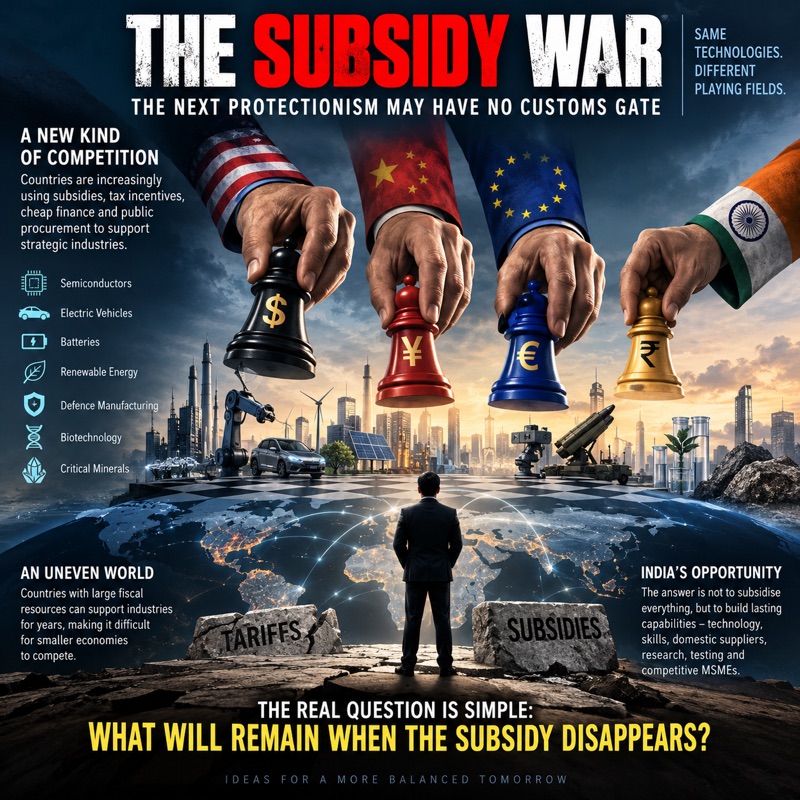
Another major transformation is emerging around critical minerals. The global race for lithium, cobalt, nickel, copper, and rare earth elements is becoming the new version of oil geopolitics. The clean energy transition is creating a massive competition for control over battery minerals, semiconductor inputs, and strategic metals. Countries are increasingly securing overseas mining assets, creating strategic reserves, and restructuring trade partnerships around resource security. The green economy itself is becoming resource intensive.
This creates a paradox. The world is attempting to move away from fossil fuel dependency, but in doing so it is creating new dependencies around critical minerals. Renewable energy systems, electric vehicles, batteries, and digital infrastructure require enormous quantities of strategic minerals. As a result, the future geopolitical map may be shaped not only by oil-rich nations but also by mineral-rich regions in Africa, Latin America, and parts of Asia.
The competition for critical minerals may eventually become more aggressive than oil competition because these resources are geographically concentrated. Countries controlling refining and processing capacities may gain disproportionate strategic power. China’s dominance in rare earth processing and battery supply chains already reflects this reality. Western economies are now urgently attempting to diversify supply chains to reduce strategic dependency. India too is trying to develop domestic capabilities, overseas mineral partnerships, and strategic reserves, but the gap remains large.
Climate change is adding another dangerous layer to commodity instability. Extreme weather events are increasingly affecting agricultural production, mining operations, shipping routes, and water availability. Heat waves, floods, droughts, and storms are no longer occasional disturbances. They are becoming structural economic risks. Food security and commodity security are now deeply interconnected with climate resilience.
The future may become even more volatile because countries are increasingly prioritizing national resource security over global market efficiency. Strategic stockpiling of grains, fuel, minerals, and fertilizers is rising globally. Export restrictions are becoming more common during crises. Nations are becoming less willing to depend excessively on open global markets during uncertain geopolitical periods. This reflects a broader shift away from globalization toward strategic economic nationalism.
The biggest concern is that global institutions appear weaker in managing these disruptions. Commodity markets are becoming fragmented by sanctions, currency conflicts, trade barriers, and strategic alliances. The world is slowly dividing into competing economic blocs with separate supply systems, payment mechanisms, and resource partnerships. Such fragmentation reduces market efficiency and increases long-term volatility.
India therefore faces a difficult balancing act. The country must simultaneously maintain growth momentum, manage inflation, protect vulnerable households, secure industrial competitiveness, and reduce strategic dependencies. Domestic manufacturing expansion alone may not solve the problem unless accompanied by deep resource security strategies. India may need stronger investments in energy diversification, domestic oilseed production, strategic reserves, recycling ecosystems, critical mineral diplomacy, and resilient logistics infrastructure.
The coming decade may fundamentally redefine the meaning of economic security. Earlier, countries focused mainly on GDP growth, exports, and foreign investment. Now, access to energy, food, minerals, shipping routes, and technological inputs may become equally important measures of national strength. Commodity markets are no longer functioning as invisible economic mechanisms. They are becoming visible instruments of geopolitical power.
The world may soon discover that the greatest economic battles of the future will not only be fought through technology or military strength, but through control over resources that sustain modern civilization itself. Commodity markets are increasingly becoming the nervous system of global power politics, and countries that fail to understand this transformation may face deep economic vulnerability despite strong growth numbers.
#CommodityMarkets #EnergySecurity #CriticalMinerals #GlobalEconomy #IndiaEconomy #ClimateRisk #Inflation #Geopolitics #SupplyChains #EconomicSecurity




No comments:
Post a Comment