
India today stands at a very important institutional crossroads. Over the last decade, the country has made significant progress in digital governance, direct benefit transfers, online approvals, faceless tax systems, digital payments, and public digital infrastructure. These changes have undoubtedly improved transparency and reduced certain forms of middle-level corruption that historically slowed economic activity. The rapid growth of digital payment systems and the integration of governance platforms have given India an image of a modernizing economy capable of handling scale. For small entrepreneurs, startups, and ordinary citizens, many government services that once required physical visits, paperwork, and informal payments are gradually becoming technology-driven and faster. This transformation is historically significant because India has long struggled with bureaucratic complexity inherited from colonial administrative systems and post-independence control-oriented economic governance.
Yet beneath this technological progress lies a deeper institutional challenge that cannot be solved by digitization alone. Economic systems ultimately depend on trust, consistency, and accountability. Many businesses in India still face uncertainty because implementation quality differs sharply across states, districts, and local administrative bodies. A policy announced at the national level may look highly attractive, but its actual execution often becomes uneven due to capacity gaps, conflicting regulations, weak coordination, or administrative delays. This creates a silent economic cost that rarely appears in official growth statistics. Investors do not only evaluate tax incentives or subsidies; they increasingly evaluate how long approvals take, whether contracts are enforceable, how disputes are resolved, and whether policies remain stable over time.
Historically, some of the fastest-growing economies in East Asia succeeded not merely because they provided incentives, but because they created institutional discipline. Countries like South Korea and Singapore built strong coordination mechanisms between government, industry, finance, and technology ecosystems. Their success came from reducing uncertainty and creating confidence in administrative systems. In contrast, many developing economies with ambitious industrial policies failed because institutional fragmentation weakened implementation. India today risks facing a similar contradiction where policy ambition moves faster than institutional preparedness.
One of the biggest emerging realities is that governance quality itself is becoming a global economic asset. In earlier decades, low wages and cheap land were enough to attract investment. Today, multinational firms operating in sectors such as electronics, semiconductors, pharmaceuticals, renewable energy, and digital services are highly sensitive to regulatory stability. Supply chains have become deeply interconnected, and disruptions caused by sudden policy changes, legal uncertainty, environmental clearances, or trade restrictions can create massive financial losses. As geopolitical tensions rise and global companies diversify production away from overdependence on a single country, nations competing for investment must now prove that their governance systems are reliable and predictable.
This shift is becoming even more visible because the global regulatory environment itself is becoming more complicated. International trade is no longer governed only by tariffs. Modern trade increasingly includes environmental compliance, carbon accounting, data governance, cybersecurity rules, labor standards, financial transparency, and technology restrictions. Businesses operating globally now face overlapping regulations from multiple jurisdictions. Europe is pushing carbon border adjustment systems. The United States is tightening technology controls and supply chain security norms. Data localization laws are rising across countries. Financial systems are under stricter anti-money laundering and digital compliance frameworks. In such an environment, countries with fragmented regulatory systems may struggle to compete despite having large markets or demographic advantages.
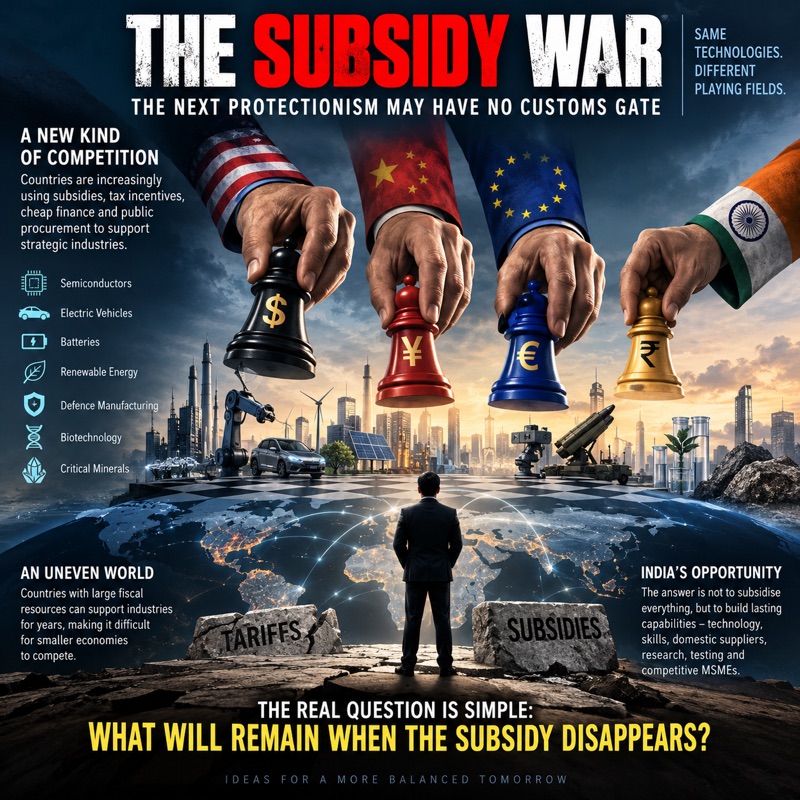
Economic nationalism is adding another layer of uncertainty. Around the world, governments are prioritizing strategic industries, domestic manufacturing, and national security-linked economic policies. The globalization model that dominated the world after the 1990s is slowly giving way to controlled globalization where economic openness is increasingly linked with strategic interests. This means businesses must continuously navigate changing rules related to exports, technology transfer, data flows, investment approvals, and industrial subsidies. In such a fragmented global order, countries with stronger institutional coordination will have a major advantage because investors prefer systems where rules are transparent and implementation is stable.
India’s challenge therefore is not merely to create policies, but to build institutional depth across all levels of governance. The gap between central policymaking and local implementation remains one of the largest barriers to sustainable growth. Urban planning authorities, pollution boards, taxation departments, municipal systems, logistics regulators, labor departments, and sectoral ministries often operate in silos. This creates overlapping approvals and inconsistent interpretation of rules. For large corporations, these inefficiencies increase operational costs. For MSMEs and informal enterprises, they often become survival challenges. The informal sector in India, which still supports millions of livelihoods, remains highly vulnerable because governance reforms often do not adequately consider local realities and implementation capacities.
Another important issue is regulatory trust. Excessive compliance complexity can unintentionally discourage entrepreneurship and innovation. When businesses feel that rules change too frequently or are interpreted inconsistently, they become defensive rather than expansion-oriented. This is particularly important for emerging sectors such as artificial intelligence, fintech, biotechnology, renewable energy, and digital commerce where innovation cycles move faster than traditional regulatory structures. If regulation becomes unpredictable, countries may lose high-value investments despite having talent and market potential.
The future may therefore witness a major shift in how nations are economically ranked. Traditional indicators such as GDP growth rates alone may become insufficient to judge long-term competitiveness. Investors and global institutions may increasingly evaluate countries on governance responsiveness, dispute resolution efficiency, judicial speed, administrative coordination, data transparency, environmental governance, and institutional credibility. In many ways, the global economy is entering a phase where governance quality may become as important as natural resources or labor availability.
India still possesses enormous strengths. Its demographic scale, digital infrastructure, entrepreneurial energy, and expanding domestic market create strong foundations for long-term growth. But sustaining that growth will require moving beyond announcement-driven governance toward institution-driven governance. The next phase of economic transformation will depend less on headline reforms and more on silent administrative efficiency. Roads, ports, and factories remain important, but the invisible infrastructure of governance may ultimately decide whether economies become resilient, innovative, and globally trusted.
The coming decade may therefore belong not necessarily to the countries with the loudest policy announcements, but to those with the most credible institutions, coordinated governance systems, and predictable regulatory environments. Economic growth in the future will increasingly be built not only in factories and financial markets, but inside the quality of institutions that quietly shape everyday economic life.
#InstitutionalQuality #GovernanceReforms #EaseOfDoingBusiness #DigitalGovernance #EconomicGrowth #RegulatoryReforms #PolicyImplementation #InvestmentClimate #EconomicNationalism #GlobalEconomy




No comments:
Post a Comment