
The historical trajectory of industrial growth explains how the world reached this point. The Industrial Revolution created unprecedented economic expansion powered by coal, oil, and mass-scale resource extraction. Developed countries built prosperity through carbon-intensive industrialization, while developing nations later followed similar models in pursuit of growth and poverty reduction. For decades, environmental damage remained an external cost hidden from mainstream economics. GDP growth was celebrated without adequately accounting for ecological destruction, groundwater depletion, air pollution, and carbon accumulation. Climate change today is essentially the delayed invoice of two centuries of unbalanced economic expansion.
India stands at a particularly sensitive intersection of climate vulnerability and developmental ambition. A large part of its economy still depends directly or indirectly on climate-sensitive sectors such as agriculture, fisheries, textiles, food processing, and informal services. Heatwaves across northern and central India are already reducing labour productivity in construction, agriculture, and small manufacturing units. Erratic monsoons are disrupting sowing cycles and reducing predictability for farmers. Water stress is becoming a silent economic crisis, particularly in industrial and urban clusters where groundwater depletion is accelerating faster than replenishment. The economic cost of climate volatility is no longer theoretical. It is visible in falling rural incomes, rising food inflation, growing energy demand, and increasing public expenditure on disaster relief.
The most critical concern is that climate disruptions disproportionately affect those with the weakest coping capacity. Large corporations may gradually adapt through technology, insurance, and diversified supply chains, but MSMEs and informal sectors remain dangerously exposed. India’s micro and small enterprises often operate with thin margins, weak infrastructure, and limited access to finance. A flood, heatwave, electricity disruption, or raw material shock can destroy years of accumulated stability. Informal workers, street vendors, artisans, and small farmers rarely possess insurance protection or climate-resilient assets. Climate change therefore risks widening inequality by creating a future where survival itself becomes linked to financial capacity.
The challenge is becoming even more complex because climate change is now deeply interconnected with global trade and industrial competitiveness. Carbon regulations introduced by developed economies are gradually transforming international trade systems. Mechanisms such as carbon border taxes and mandatory climate disclosures are redefining market access. Countries and industries with high carbon intensity may increasingly face barriers in exports, financing, and investments. This marks a historical transition where environmental efficiency becomes an economic weapon. Nations unable to align with green standards may face a new form of economic exclusion.
India’s manufacturing sector, especially traditional MSME clusters, faces a difficult transition in this emerging environment. Many industrial clusters still rely on outdated technologies, inefficient energy systems, and fragmented supply chains. Without technological upgrading and green financing support, these enterprises may struggle to remain globally competitive. The danger lies in creating a two-speed economy where large corporations successfully transition toward sustainability while smaller enterprises become economically marginalized. Climate transition without inclusion can create social instability as serious as climate disasters themselves.
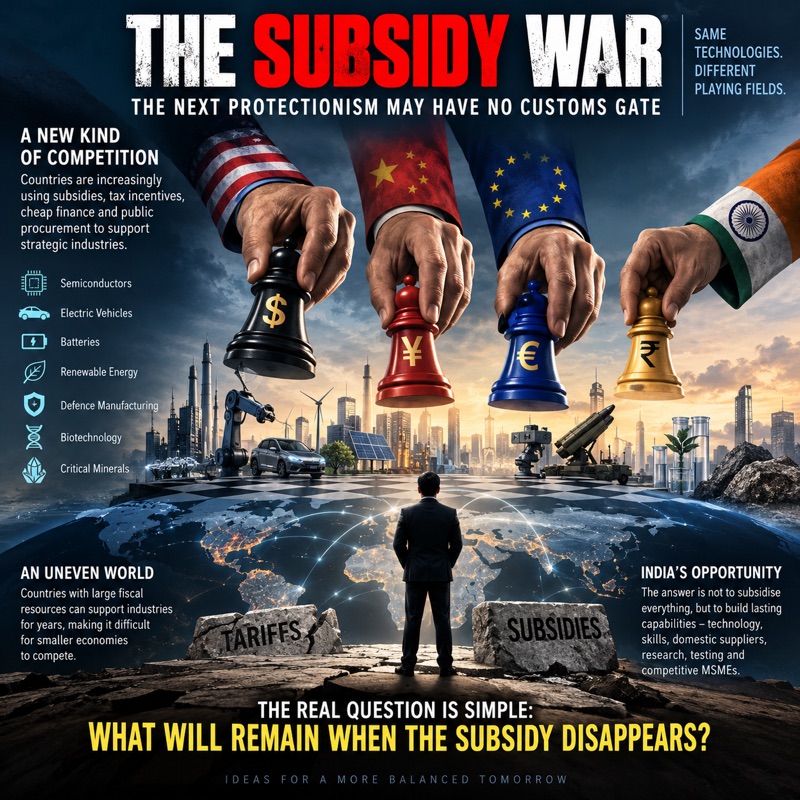
At the same time, climate change is also creating a new global competition around green technologies and climate finance. Renewable energy, battery storage, hydrogen, electric mobility, carbon capture, sustainable materials, and climate-resilient infrastructure are becoming strategic sectors similar to oil and heavy industry in earlier eras. Countries are racing to dominate future green supply chains. China has already built strong positions in solar manufacturing, battery processing, and critical mineral supply chains. The United States and Europe are aggressively subsidizing clean technologies through industrial policies and strategic funding programs. The future may witness a green industrial race where technology leadership determines geopolitical influence.
India has made significant progress in renewable energy expansion and climate diplomacy, but structural gaps remain large. Investments in resilient infrastructure, disaster preparedness, and renewable capacity are increasing, yet implementation challenges persist at the local level. Climate adaptation remains uneven across states and districts. Urban planning often ignores heat resilience and water sustainability. Rural adaptation strategies are fragmented and underfunded. Many policies still focus more on announcing targets than creating institutional systems capable of long-term execution.
Insurance economics is another emerging area of concern. Climate-sensitive regions across the world are witnessing sharp increases in insurance costs. In some cases, insurers are even withdrawing coverage from disaster-prone zones due to rising risks. This creates a dangerous cycle where vulnerable populations become financially unprotected precisely when risks are increasing. For developing countries like India, where insurance penetration itself remains relatively low, climate-linked financial vulnerability may become a major socioeconomic issue in the coming decades.
Migration patterns are also slowly changing under climate pressures. Water scarcity, declining agricultural productivity, coastal erosion, and extreme weather events may accelerate internal migration toward urban areas. Indian cities, many of which are already struggling with congestion, pollution, and infrastructure stress, may face intensified pressure. Climate migration is not only a humanitarian issue; it is also an economic and governance challenge. Labour markets, housing systems, healthcare services, and social cohesion may increasingly be shaped by environmental pressures.
The future economic model of the world may therefore depend less on unlimited expansion and more on resilience, adaptability, and sustainability. The definition of competitiveness itself is changing. In the past, low-cost production and cheap labour were considered major advantages. In the coming decades, resilience against climate disruptions, energy efficiency, circular resource use, and carbon management may become equally important indicators of economic strength.
Yet there is also a deeper philosophical question emerging beneath the climate debate. Modern economic systems were built on the assumption that nature was an infinite resource available for exploitation. Climate change is forcing humanity to confront the limits of that assumption. The crisis is not merely environmental. It is civilizational. It challenges the idea that growth can continue indefinitely without ecological balance. Future economies may need to redefine prosperity itself, moving from excessive consumption toward sustainable well-being.
For India, the path forward cannot simply be copied from developed economies because the country still carries the burden of poverty, employment generation, and developmental aspirations. The real challenge is balancing growth with sustainability without sacrificing social inclusion. Climate policy cannot become anti-poor policy. Green transitions must generate jobs, support MSMEs, strengthen rural resilience, and democratize access to technology and finance. Otherwise, sustainability itself may face resistance from those struggling for survival.
The coming decades may therefore witness a complete restructuring of economic priorities across the world. Climate change is no longer a side discussion attached to economics. It is gradually becoming the framework within which future economics itself will operate. Nations that understand this transition early and build inclusive resilience may emerge stronger. Those that delay adaptation may face not only environmental instability but also economic fragmentation, social unrest, and strategic decline.
#ClimateChange #GreenEconomy #MSME #Sustainability #ClimateFinance #CarbonEconomy #RenewableEnergy #IndustrialCompetitiveness #ClimateAdaptation #FutureEconomy




No comments:
Post a Comment