Budget 2026: Sector-Wise Transformation Signals for MSMEs, Textiles, Rare Earths, Tourism & the Rural Economy
The Union Budget this year sends a decisive message: India is preparing its productive sectors for a decade of structural transformation, not a single-year stimulus cycle. At a time when global growth is subdued, trade is fragmenting, and capital is becoming selective, India’s approach is shifting from broad-based incentives to targeted capability creation—especially in sectors that influence jobs, exports, and strategic security.
Below is a sector-wise blog-style analysis connecting the Budget’s announcements with long-term opportunities across key sectors important to your work: MSMEs, Textiles, Rare Earths, Tourism, and the Rural Economy.
1. MSMEs: Formalisation 2.0 & Productivity Leap, Not Subsidy Push
This Budget marks a shift from short-term credit expansion to structural competitiveness. MSMEs—90% of India’s industrial base—are now positioned at the centre of a digital-productivity transition.
Key Signals from the Budget
• A new Digital Compliance Grid aims to reduce 30–40% of redundant filings by integrating MCA, GST, EPFO, ESIC, and DGFT systems.
• The government has earmarked additional funds for credit guarantee expansion, but the focus is on risk-based lending, leveraging GST cash flow histories.
• A revamped MSME Export Readiness Scheme targets 10,000 small exporters with market intelligence and product standards training.
Futuristic Outlook
The next five years will not be about protection, but capability upgradation:
• AI-led manufacturing diagnostics will become mandatory for credit-linked capital subsidies.
• Clusters will move from physical incubation to “Digital Clusters”—remote quality audits, AR-based machine repair, and cloud-based production planning.
Critical Take
MSME success now depends less on incentives and more on:
• adopting standards
• building cross-border linkages
• and integrating with global supply chains reshaped by EU CBAM, US friend-shoring, and rising non-tariff barriers.
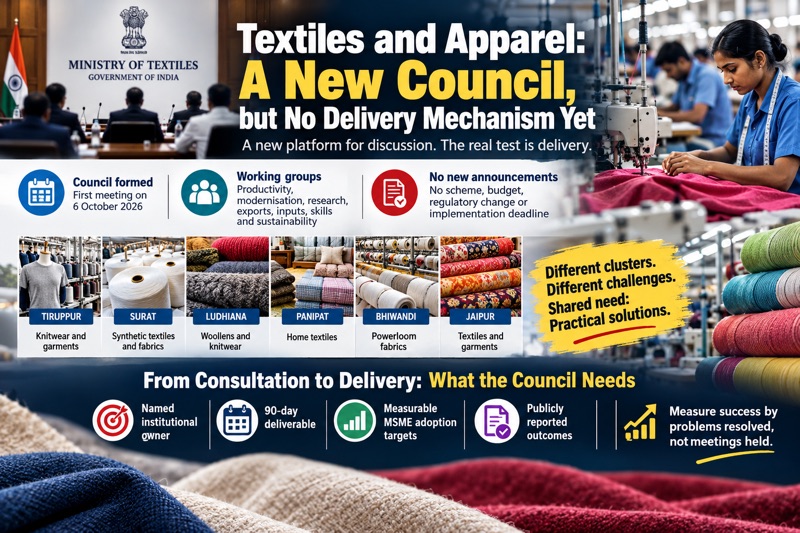
2. Textiles: The Budget Quietly Pushes a High-Tech Reinvention
Textiles—one of India’s biggest job creators—is being pushed toward technical, green, and high-value manufacturing, instead of volume-based exports.
What the Budget Signals
• Expansion of the PLI for Technical Textiles with a new focus on:
o medical textiles
o defence textiles
o geotextiles
o sustainable fibres
• A new Green Textile Transition Fund for wastewater recycling and compliance with EU Green Deal norms.
• Duty rationalisation for advanced textile machinery, preparing India for Industry 4.0 adoption in weaving and garmenting.
Futuristic Outlook
By 2030, the textile sector will split into two layers:
1. Value-added manufacturing for global supply chains (MMF, technical textiles, recycled fibres)
2. Design-led micro production for domestic consumption and D2C brands
The winners will be clusters that combine design + sustainability + automation.
Critical Take
Unless India fixes:
• labour productivity
• last-mile logistics
• and compliance capability
…textiles may lose ground to Vietnam, Bangladesh, and even African nations entering low-duty windows.
3. Rare Earths & Strategic Minerals: Budget Makes a Geopolitical Pivot
This is the most strategically important part of the Budget for India's industrial future.
Key Announcements
• A ₹7,000+ crore allocation for the National Rare Earth Mission, with clear targets for:
o mining expansion
o separation and refining
o magnet manufacturing
• Permission for private sector participation in rare earth extraction and magnet manufacturing under strict traceability norms.
• A new Indo-Pacific Critical Mineral Alliance Fund to secure lithium, cobalt, and REE investments in Australia, Africa, and Latin America.
Futuristic Outlook
India aims to become a top-5 player in permanent magnets for electric vehicles, consumer electronics, drones, and defence platforms.
This is vital because:
• China controls 85%+ of rare earth processing
• The world is reconfiguring supply chains
• India’s EV, defence, and electronics ambitions depend on secure magnet supply
Critical Take
Success depends on:
• Deep R&D
• Long-term offtake agreements
• Strong environmental safeguards
• and the ability to match Chinese efficiency
Rare earths could become India’s “semiconductor moment”—but only if public and private sectors act with precision.
4. Tourism: The Budget Shifts from Domestic Boost to Global Positioning
India is preparing to compete with Southeast Asia for global travellers.
Budget Signals
• Launch of 5 Iconic International Tourism Circuits (including Himalayan spiritual, coastal blue economy, and heritage circuits).
• A new Tourism Infrastructure Fund with blended finance for airports, ropeways, digital ticketing, and last-mile connectivity.
• Incentives for film tourism and MICE tourism, linking Indian states with global event organisers.
Futuristic Outlook
By 2032, tourism will be powered by:
• immersive digital storytelling
• experience-led micro entrepreneurship
• eco-sensitive travel
• seamless multimodal connectivity
The Budget’s emphasis on “high-spending global tourists” shows a shift from volume to value.
Critical Take
Tourism will only scale if:
• safety
• cleanliness
• and global service standards
are addressed—areas where India still lags.
5. Rural Economy: Quiet but Structural Transformation
The rural economy is not receiving headline-grabbing cash transfers; instead, the Budget focuses on resilience, productivity, and digital empowerment.
Budget Signals
• Expansion of digital agriculture platforms for soil mapping, predictive irrigation, and crop advisories.
• New incentives for agri-processing clusters in districts with high FPO density.
• A revamped PM-Grameen 4.0 initiative for rural roads, logistics hubs, and digital service centers.
Futuristic Outlook
Rural India will gradually transition from:
• subsistence farming → value-added farming
• physical mandi reliance → hybrid online-offline marketplaces (ONDC-enabled)
• informal labour → digital wage tracking
Critical Take
The rural economy must confront:
• water distress
• climate volatility
• low farm incomes
• low-quality non-farm jobs
Without addressing these, rural demand will continue its structural stagnation—impacting MSMEs and consumption-led growth.
Conclusion: The Budget Is a Blueprint for Strategic Sectors, Not a Populist Document
This Budget signals a decade-long shift from subsidies to sector-specific capability building.
The government aims to prepare India for:
• green supply chains
• geopolitical realignment
• high-tech manufacturing
• services-led export dominance
For MSMEs, textile units, rare earth manufacturers, tourism operators, and rural entrepreneurs, the message is clear:
Competitiveness—not protection—will define survival and scale.




No comments:
Post a Comment