The Changing Logic of Free Trade

However, the global economic landscape that supported this philosophy is undergoing a profound transformation. Trade today is increasingly shaped not only by economic efficiency but also by geopolitical competition, national security considerations, and technological rivalry. In this emerging environment, the question for India is no longer simply whether free trade is beneficial, but whether the traditional model of free trade remains adequate in a fragmented global economy.
From Globalization to Fragmentation
The world economy is gradually moving away from the hyper-globalization that characterized the period between the 1990s and the mid-2000s. During that period, global trade expanded at nearly twice the rate of global GDP, multinational supply chains stretched across continents, and trade barriers were steadily reduced. Countries relied heavily on international networks for manufacturing inputs, technology, and energy supplies.
Today, the situation looks markedly different. Trade tensions between major powers, technological decoupling, sanctions regimes, and geopolitical conflicts are reshaping global commerce. The COVID-19 pandemic exposed the vulnerabilities of long and highly concentrated supply chains. More recently, conflicts in regions such as the Middle East and disruptions in critical maritime routes have reminded policymakers that global trade routes are not always secure. Governments are increasingly prioritizing resilience and strategic autonomy alongside economic efficiency.
In such a fragmented system, trade agreements are no longer purely economic instruments. They have become tools of strategic alignment. Countries are forming economic blocs, creating trusted supply networks, and promoting domestic manufacturing capabilities in sectors considered critical for national security.
India’s Historical Approach to Trade Policy
India’s relationship with global trade has always been shaped by a tension between openness and self-reliance. In the decades immediately following independence, the country adopted a relatively protectionist model, emphasizing import substitution and domestic industrialization. High tariffs and strict licensing systems were designed to protect local industries from foreign competition.
The economic reforms of 1991 marked a turning point. India progressively reduced tariffs, liberalized trade policies, and encouraged integration with global markets. Export sectors such as information technology, pharmaceuticals, and automotive components flourished during this period. India’s share in global trade increased steadily, and the country emerged as an important participant in services exports.
Yet even during this phase of liberalization, India remained cautious about certain trade agreements. Concerns about domestic industry competitiveness and employment often shaped the country’s approach. The decision not to join the Regional Comprehensive Economic Partnership (RCEP) reflected these concerns, as policymakers feared that excessive imports could weaken domestic manufacturing.
The Emerging Trade Reality
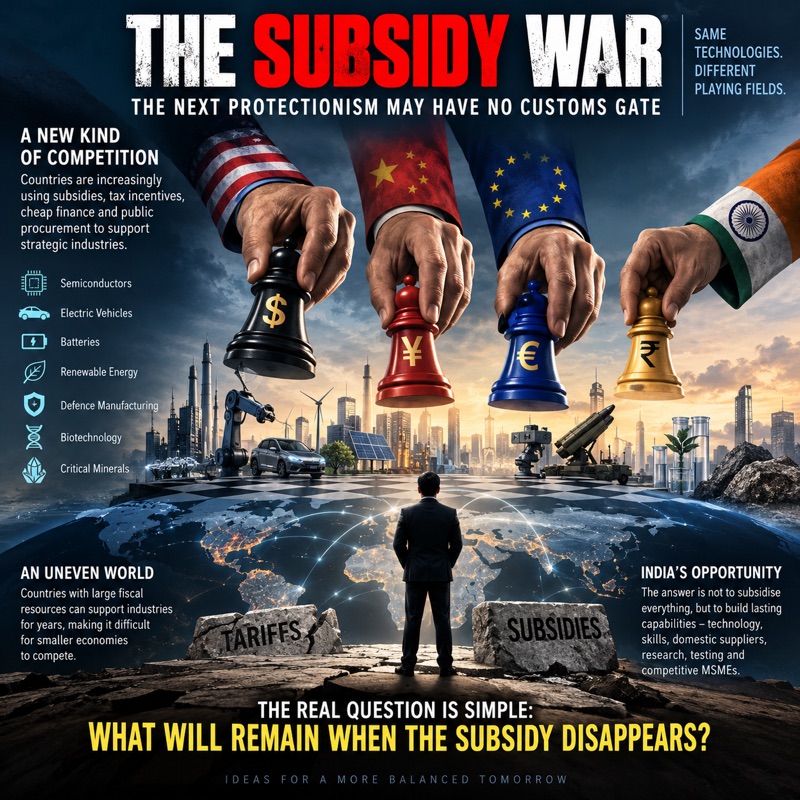
The global trade system now operates in an environment where strategic competition plays a central role. Governments are offering large subsidies to support domestic industries in sectors such as semiconductors, renewable energy technologies, artificial intelligence, and advanced manufacturing. Trade policies are increasingly intertwined with industrial strategies.
Major economies are actively reshaping supply chains through initiatives such as “friend-shoring,” “near-shoring,” and strategic stockpiling of critical minerals. These developments signal a shift from purely market-driven globalization toward a more politically managed system of trade.
For India, this transformation creates both opportunities and challenges. On the one hand, the reorganization of global supply chains could allow India to attract new manufacturing investments as companies seek alternatives to existing production hubs. On the other hand, rising protectionism and geopolitical tensions could disrupt export markets and create uncertainty for trade-dependent sectors.
Balancing Openness with Strategic Autonomy
In this new environment, India’s trade strategy may need to evolve beyond the traditional binary choice between protectionism and free trade. The challenge is to design a hybrid model that combines openness with strategic resilience.
Such a model would involve selectively integrating into global supply chains while simultaneously strengthening domestic industrial capabilities. Trade agreements would not only focus on tariff reductions but also address technology cooperation, supply chain security, and regulatory alignment.
For instance, India may prioritize trade partnerships with countries that share long-term strategic interests and complementary economic strengths. These partnerships could help create stable supply chains for critical technologies, energy resources, and industrial inputs. At the same time, domestic policies such as production-linked incentives and industrial infrastructure investments could strengthen India’s manufacturing base.
The Manufacturing Imperative
One of the central debates in India’s economic policy revolves around the role of manufacturing in the country’s development trajectory. While services have driven much of India’s export success, manufacturing remains essential for large-scale employment generation and technological advancement.
A fragmented global economy may actually strengthen the case for building a robust domestic manufacturing ecosystem. As global firms diversify production locations, countries with strong industrial infrastructure and skilled workforces are likely to attract investment. If India can develop competitive manufacturing clusters, improve logistics, and ensure regulatory stability, it could position itself as a key node in the reconfigured global supply chain.
However, achieving this outcome requires a coordinated strategy that links trade policy with industrial policy, education, infrastructure development, and technological innovation.
Trade Agreements as Strategic Partnerships
In the emerging global order, trade agreements are evolving into broader economic partnerships that encompass technology collaboration, investment frameworks, and digital governance. Countries are increasingly negotiating agreements that address issues such as data flows, intellectual property, environmental standards, and supply chain transparency.
For India, this shift means that future trade agreements must be designed with long-term strategic objectives in mind. Rather than pursuing numerous agreements purely for market access, India may benefit from focusing on a smaller number of deep partnerships that strengthen technological capabilities and industrial competitiveness.
Such partnerships could also support India’s ambition to become a bridge between advanced economies and the Global South, facilitating trade and investment flows across diverse regions.
A Futuristic Outlook for India’s Trade Strategy
Looking ahead, India’s trade policy will likely operate in a world characterized by overlapping economic blocs, strategic supply chains, and rapid technological change. The challenge will not simply be to maximize exports, but to ensure that trade contributes to national resilience, technological progress, and inclusive economic growth.
If India can combine strategic trade partnerships with strong domestic capabilities, it could emerge as one of the most important economic hubs in the evolving global system. The country’s large domestic market, demographic advantage, and growing technological ecosystem provide a strong foundation for this transformation.
Ultimately, the question is not whether India should abandon free trade, but how it should redefine it for a new era. In a fragmented global economy, the most successful nations will be those that treat trade policy not merely as an economic tool but as a central component of their long-term development strategy.
#GlobalTrade
#IndiaTradePolicy
#EconomicFragmentation
#SupplyChainResilience
#StrategicAutonomy
#ManufacturingIndia
#TradeAgreements
#Geoeconomics
#IndustrialPolicy
#FutureOfGlobalization




No comments:
Post a Comment