
The Structural Trap: Fragmentation, Low Productivity, and Disguised Employment
At the heart of the crisis lies the fragmentation of landholdings, with over 85% of farmers classified as small and marginal. This has locked Indian agriculture into a low productivity–high dependency equilibrium, where nearly half the workforce depends on agriculture, but the sector contributes barely 15–16% to GDP. The result is disguised unemployment, low per capita income, and persistent rural poverty. Growth becomes statistically visible, but income transformation remains absent, making equity elusive.
Market Failure and the Illusion of Price Support
One of the most critical failures has been the inability of farmers to realize fair prices. While the Minimum Support Price (MSP) system exists, its benefits are largely confined to a few crops and regions, leaving a majority of farmers exposed to volatile markets. Intermediary-driven mandi systems, weak integration with national and global markets, and lack of storage infrastructure force farmers into distress sales. In a globalized economy, where supply chains determine competitiveness, Indian farmers remain price takers rather than price makers, undermining both growth incentives and income equity.
Rising Costs, Stagnant Incomes: The New Agrarian Squeeze
A major contemporary challenge is the growing mismatch between rising input costs and stagnant output prices. Fertilizers, diesel, seeds, and labour costs have increased significantly, while farm-gate prices have not kept pace. This has created a cost-price squeeze, pushing farmers into cycles of indebtedness. Institutional credit expansion has not fully addressed this issue, as small farmers continue to depend on informal lenders. The result is not just economic stress but also social vulnerability, reflected in migration and distress patterns.
Climate Change and Water Crisis: The Emerging Structural Shock
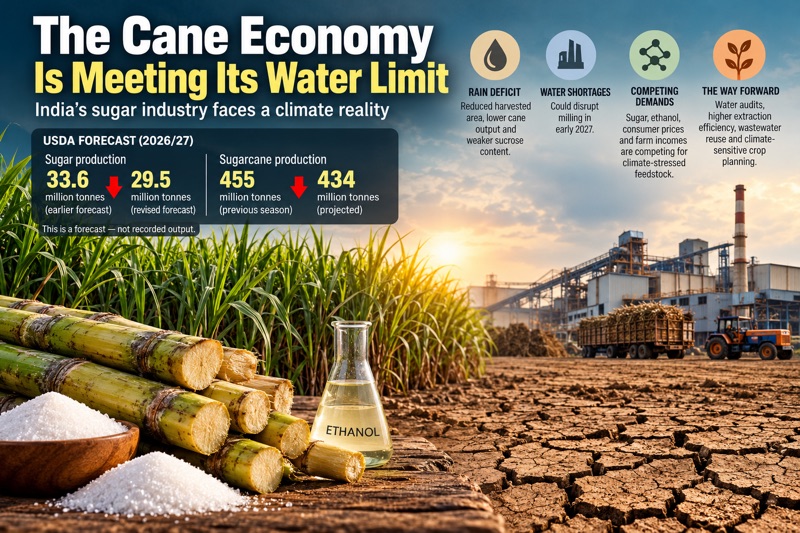
Unlike earlier decades, today’s agriculture is increasingly shaped by climate volatility. Erratic monsoons, rising temperatures, groundwater depletion, and extreme weather events are no longer exceptions but the new normal. Regions like Punjab and Haryana face groundwater exhaustion due to decades of policy-induced cropping patterns, while rain-fed regions remain highly vulnerable. Climate change is thus not just an environmental issue—it is a growth and equity disruptor, disproportionately affecting small and marginal farmers who lack resilience mechanisms.
Technological Divide: The Unequal Future of Farming
While the global agricultural landscape is rapidly moving towards precision farming, AI-driven crop management, and digital marketplaces, Indian agriculture is witnessing a dual-speed transformation. A small segment of progressive farmers and agri-startups is adopting technology, while a vast majority remains excluded due to lack of awareness, affordability, and digital infrastructure. This creates a technology-driven inequality, where future gains in productivity and income may be concentrated among a few, widening rural disparities.
Weak Value Chains and Post-Harvest Losses: Missing the Real Growth Opportunity
A significant portion of agricultural produce in India is lost due to inadequate storage, cold chain infrastructure, and processing capacity. Even where production is high, value addition remains minimal. This reflects a deeper issue—Indian agriculture is still production-centric rather than value-chain-centric. Without integration into processing, branding, and export systems, farmers are unable to capture higher value, limiting both growth potential and income distribution.
Regional Imbalance and Policy Distortion
Agricultural growth in India has been uneven, with certain regions benefiting disproportionately from irrigation, subsidies, and infrastructure. Eastern India, tribal areas, and rain-fed regions continue to lag behind. Policy interventions, often designed at the national level, fail to account for this diversity. Moreover, excessive reliance on subsidies—fertilizer, power, water—has created distortions that encourage inefficient resource use rather than productivity enhancement. This leads to fiscal burden without structural transformation.
Global Pressures, Trade Barriers, and Sustainability Compliance
A major contemporary challenge emerging rapidly is the increasing integration of agriculture with global trade regimes. Issues such as carbon border taxes, sustainability standards, traceability requirements, and sanitary-phytosanitary norms are becoming critical determinants of export competitiveness. Indian agriculture, largely unorganized and fragmented, is not fully prepared for this shift. Without alignment to global standards, India risks losing market share even in traditional export sectors.
From Food Security to Income Security: The Policy Shift Required
The fundamental policy challenge is that Indian agriculture has been historically designed around food security, not farmer income. This has resulted in policies that prioritize production of certain crops rather than diversification, value addition, or income maximization. The future requires a shift towards income-centric agriculture, where success is measured not by output levels but by farmer prosperity.
Reimagining Agriculture as an Enterprise Ecosystem
The future of Indian agriculture lies in moving beyond subsistence farming towards an integrated, enterprise-driven model. This includes cluster-based development, farmer producer organizations (FPOs), digital platforms, and stronger linkages with industry and exports. Technology must be democratized, not concentrated. Water and climate resilience must become central to planning. Most importantly, agriculture must be seen not as a welfare sector, but as a strategic economic sector driving rural transformation.
The Real Question is Structural Transformation, Not Incremental Reform
Indian agriculture does not suffer from lack of effort or policy attention—it suffers from a lack of structural alignment between productivity, markets, and equity. Growth without equity will deepen rural distress, while equity without productivity will make the sector fiscally unsustainable. The real challenge is to transition from a fragmented, subsidy-driven system to a competitive, resilient, and inclusive agricultural economy, where farmers are not just producers but participants in value creation.
#IndianAgriculture
#FarmerIncome
#ClimateResilience
#AgriReforms
#RuralEconomy
#MSP
#AgriValueChains
#FoodSecurity
#SustainableFarming
#AgriExports




No comments:
Post a Comment