
From Industrial Strength to Structural Fatigue
Historically, Europe built its strength on efficient manufacturing clusters, stable institutions, and access to relatively affordable energy. However, recent disruptions, including energy price shocks, climate compliance costs, and geopolitical tensions, have altered this equation. Industries such as automotive, chemicals, and heavy engineering are witnessing declining margins and cautious investment behavior. When European industries slow down, the immediate impact is visible in reduced imports of capital goods. For Indian exporters, particularly in engineering and machinery sectors, this translates into shrinking order books and heightened uncertainty.
Yet this slowdown is not merely cyclical. It reflects a deeper transformation where Europe is shifting towards sustainability-driven production, digital manufacturing, and reduced dependence on external supply vulnerabilities. This transition phase naturally creates a temporary drag on industrial output and investment.
The Demand Shock and Its Uneven Impact
The decline in European demand is not uniform across sectors. High-value capital goods and specialized machinery are seeing sharper contractions, while segments linked to green technologies are still attracting investments. This unevenness creates a complex environment for exporters. Indian firms that are dependent on traditional industrial segments may face immediate challenges, while those aligned with emerging sectors such as renewable energy equipment or precision engineering may still find opportunities.
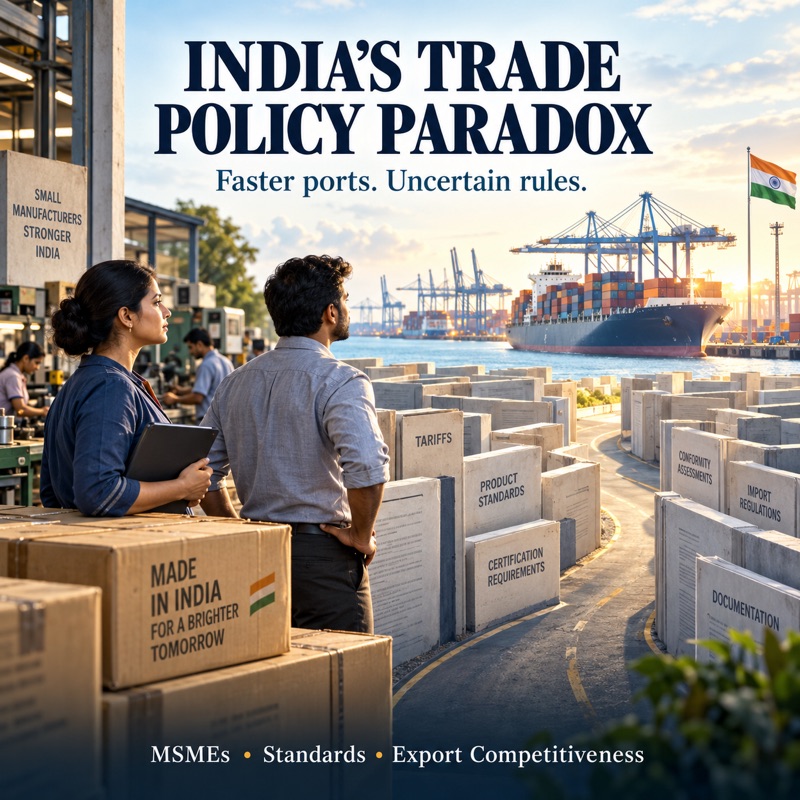
At a human level, this slowdown is not just about trade numbers. It affects workers in factories in Europe, but it also quietly impacts small manufacturers in India who depend on export orders. A machine tool manufacturer in Coimbatore or a component supplier in Ludhiana feels this slowdown not as a statistic, but as fewer shifts, delayed payments, and cautious hiring decisions.
Supply Chain Realignment and the Rise of New Manufacturing Geography
While Europe slows down, the global manufacturing map is being redrawn. Supply chain disruptions over the past few years have pushed companies to rethink their dependence on single geographies. The idea of efficiency is gradually being replaced by the idea of resilience. This is where India finds itself at a strategic crossroads.
Global firms are increasingly looking for alternative manufacturing bases that offer cost competitiveness, policy stability, and scale. India, with its large domestic market, improving infrastructure, and policy initiatives, is emerging as a credible option. The shift is not automatic, but it is gaining momentum. Sectors such as electronics, pharmaceuticals, textiles, and auto components are seeing gradual integration into global supply chains.
However, this opportunity comes with its own challenges. Competing with countries like Vietnam, Mexico, and Indonesia requires not just cost advantages but also reliability, speed, and compliance with global standards. Infrastructure gaps, logistics inefficiencies, and regulatory complexities still act as barriers that need urgent attention.
India at the Crossroads of Opportunity and Preparedness
India’s potential to benefit from supply chain realignment is significant, but it is not guaranteed. The real question is whether India can move from being an alternative to becoming a preferred destination. This requires a shift from fragmented manufacturing to integrated ecosystems where clusters, logistics, skills, and technology come together seamlessly.
The role of MSMEs becomes critical in this transition. Large investments may attract global attention, but it is the network of small and medium enterprises that determines depth and resilience in manufacturing. Strengthening these enterprises through technology adoption, access to finance, and global market linkages will define India’s success in capturing this opportunity.
From a policy perspective, consistency and long-term vision are essential. Incentive-driven growth can initiate investment, but sustainable competitiveness comes from productivity, innovation, and institutional strength.
A Futuristic Outlook on Industrial Balance
Looking ahead, the global industrial landscape is likely to become more distributed and less concentrated. Europe may not disappear as a manufacturing powerhouse, but its role may evolve towards high-tech, sustainable, and specialized production. At the same time, countries like India may take on a larger share of volume manufacturing and diversified supply chains.
The future will not be about replacing one geography with another, but about creating a network of interconnected manufacturing hubs. In this network, resilience, sustainability, and technological capability will matter more than just cost.
For India, this moment is both an opportunity and a test. It is an opportunity to step into a larger role in global manufacturing, but it is also a test of how quickly and effectively it can adapt. The story is still unfolding, and its direction will depend not just on policies and investments, but on the everyday decisions of entrepreneurs, workers, and institutions who together shape the industrial future.
In the end, behind every global shift lies a human story of adjustment, aspiration, and resilience. The slowdown in Europe and the rise of new manufacturing destinations like India are not isolated events. They are chapters in a larger narrative of how economies evolve, adapt, and redefine themselves in a changing world.
#IndustrialShift #GlobalManufacturing #SupplyChainResilience #IndiaOpportunity #CapitalGoods #MSMEGrowth #TradeDynamics #EconomicTransition #ManufacturingFuture #ExportStrategy




No comments:
Post a Comment