
Strengthening Farmer–Industry Ties
The sugar industry in India is a lifeline for millions of farmers. Yet, it has been trapped in cycles of excess production, falling sugar prices, and delayed payments to cane growers. By diversifying output toward ethanol, mills gain a new revenue stream that reduces dependence on volatile sugar markets. For farmers, this translates into timely payments, reduced arrears, and greater price stability.
Critically, ethanol blending mandates also mean that farmers are no longer entirely at the mercy of global sugar trade dynamics, where price crashes often wipe out their incomes. Instead, they are integrated into a domestic energy security agenda—a strategic repositioning that strengthens the political economy of sugarcane.
Energy Security and Climate Goals
India imports nearly 85% of its crude oil requirements, making fuel security a constant pressure on foreign exchange reserves. Ethanol blending, while not a silver bullet, can substantially cut fuel import bills. For example, 10% blending in 2022–23 saved nearly ₹41,500 crore in import costs. Doubling this to 20% by 2025 could magnify the savings and reduce vulnerability to global oil price shocks.
From a climate perspective, ethanol offers a lower carbon footprint compared to fossil fuels. According to the Ministry of Petroleum and Natural Gas, ethanol blending in 2022 reduced around 2.7 million tonnes of CO₂ emissions. With the new policy push, these environmental gains can scale further, aligning with India’s net zero by 2070 ambition.
Industrial Diversification and Rural Employment
Ethanol production creates a multi-industry synergy. Beyond sugar, allied industries in biofuels, logistics, distilleries, and renewable energy expand employment opportunities. The distillery capacity in India has already grown from 200 crore litres in 2014 to over 900 crore litres in 2023, and further expansion will be needed to meet the 20% target.
This expansion also incentivizes technology adoption—from efficient fermentation techniques to better waste utilization, such as press mud and bio-CNG generation. Rural industrial clusters built around ethanol can thus become hubs of green economic activity, reducing the rural-urban divide.
Critical Challenges Ahead
While the policy shift is bold, its implementation must be carefully managed:
1. Food vs. Fuel Debate: Diverting sugarcane juice for ethanol could raise concerns about availability of sugar for domestic consumption. Policymakers will need to balance food security with energy security.
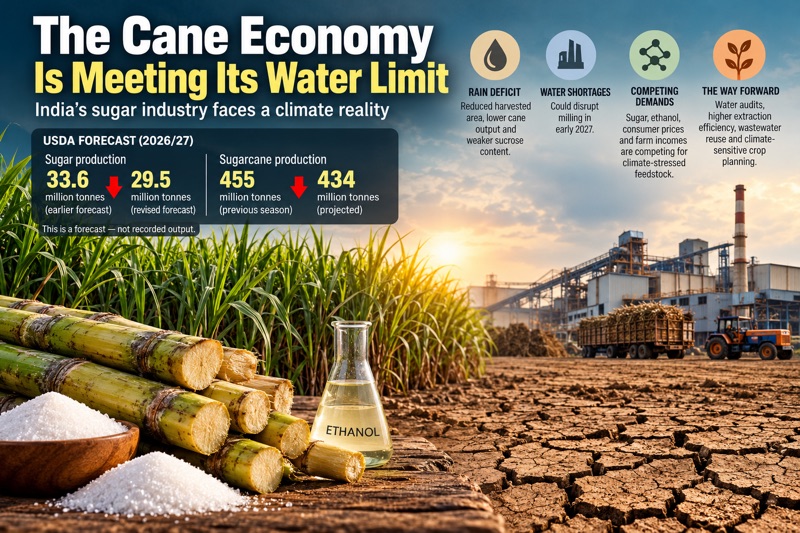
2. Water Intensity of Cane: Sugarcane is a water-guzzling crop, raising sustainability concerns in drought-prone regions. Expanding ethanol production must go hand-in-hand with crop diversification toward less water-intensive feedstocks like maize and surplus grains.
3. Pricing and Subsidy Framework: Ensuring fair pricing for ethanol, without overburdening oil marketing companies (OMCs) or requiring perpetual subsidies, is key for long-term viability.
4. Regional Imbalances: Ethanol production is heavily concentrated in states like Uttar Pradesh, Maharashtra, and Karnataka. Encouraging broader participation from other states can prevent regional skew and promote equitable rural development.
A Step Toward Sustainable Ag-Energy Synergy
India’s ethanol policy marks more than a fuel substitution exercise; it is a structural reform in the agriculture–industry nexus. By creating a stable domestic demand for sugarcane and strengthening rural industries, it addresses both farmer welfare and energy security. However, its success hinges on addressing water use, ensuring food balance, and building inclusive regional strategies.
If managed wisely, this policy can transform ethanol from a niche biofuel into a pillar of India’s green growth story, anchoring a future where agriculture and industry move forward hand in hand.#EthanolPolicy
#AgriIndustry
#BiofuelIndia
#SugarcaneEconomy
#EnergySecurity
#ClimateAction
#FarmersIncome
#GreenGrowth
#SustainableDevelopment
#NetZeroIndia




1 comment:
Well written and thought provikig article.
Post a Comment